

Kanawha and West Virginia Railroad Co. Transferred to William K. Vanderbilt, Jr. - Stock Certificate
Inv# AG1909 Stock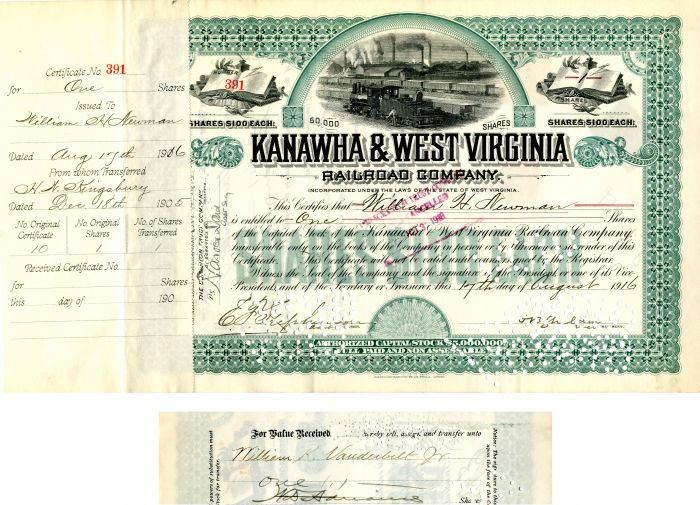
Stock transferred to William K. Vanderbilt, Jr., not signed.
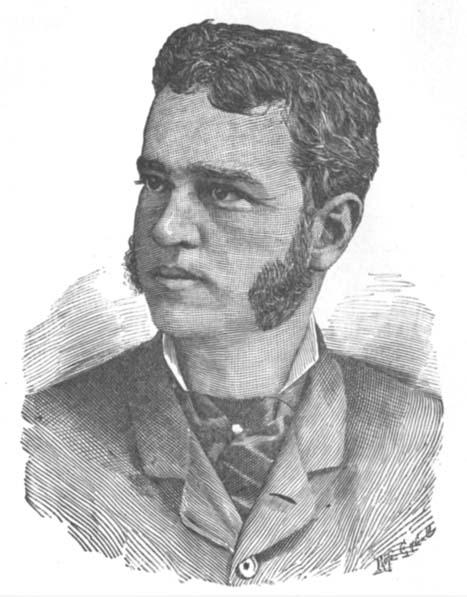
William Kissam Vanderbilt, born in 1849 and passing away in 1920, was a prominent American railroad executive and horse breeder who epitomized the opulence of the Gilded Age. As the grandson of the renowned Cornelius Vanderbilt, known as “The Commodore,” Vanderbilt inherited the family’s vast railroad interests. He served as the vice president of the New York Central Railroad before assuming leadership after his brother’s passing in 1899.
While his business achievements were remarkable, Vanderbilt’s true passions lay in high society and architecture. He and his first wife, Alva Smith, collaborated on designing some of the era’s most renowned residences, including the Petit Chateau on Fifth Avenue and Marble House in Newport.
In his later years, Vanderbilt’s interests shifted to his love for thoroughbred horse racing and yachting. He was a co-founder of The Jockey Club and eventually relocated to France, where he established the Haras du Quesnay, one of the most successful racing stables in Europe. Vanderbilt’s legacy continued through his son, William Kissam Vanderbilt II, who shared his father’s fascination with speed and founded the Vanderbilt Cup for auto racing. Upon his passing in Paris in 1920, Vanderbilt was returned to the United States and interred in the family mausoleum on Staten Island.
The Kanawha and West Virginia Railroad (K&WV) was a crucial short-line railroad that primarily transported the abundant coal and timber resources of the Blue Creek basin in West Virginia. Established in 1903 as the Imboden and Odell Railroad, the line was constructed in the early 1900s to exploit the region’s natural resources. However, an unexpected development occurred when the great Blue Creek oil field was discovered shortly after its construction, leading to a temporary boom characterized by the drilling of oil derricks alongside the tracks. Throughout its existence, the K&WV served the Elk River area, carrying substantial freight traffic, particularly coal, and providing essential passenger service, including dedicated “school” trains that operated until the early 1960s due to the remote nature and limited road access of the region.
The K&WV’s corporate structure was intricate, but through a series of controlling interests, the company was ultimately controlled by the New York Central Railroad (NYC). The NYC eventually leased the K&WV, formally integrating it into its extensive system in 1952. Among its segments, the 34-mile section from Blue Creek to Blakely was its most profitable. Over time, the K&WV line was absorbed into subsequent rail systems, including Penn Central and then Conrail. The old K&WV route between Charleston and Blue Creek was abandoned around 1970, with train movements rerouted via trackage rights over the Baltimore & Ohio (B&O) on the opposite side of the Elk River. The current incarnation of the railroad in the area is the Kanawha River Railroad (KNWA), a subsidiary of Watco, which leases and operates lines from Norfolk Southern, primarily hauling coal and chemicals.
A stock certificate is issued by businesses, usually companies. A stock is part of the permanent finance of a business. Normally, they are never repaid, and the investor can recover his/her money only by selling to another investor. Most stocks, or also called shares, earn dividends, at the business's discretion, depending on how well it has traded. A stockholder or shareholder is a part-owner of the business that issued the stock certificates.




Ebay ID: labarre_galleries