

Cleveland and Pittsburgh Railroad Co. - 1960's-70's dated Railway Stock Certificate
Inv# RS1060 Stock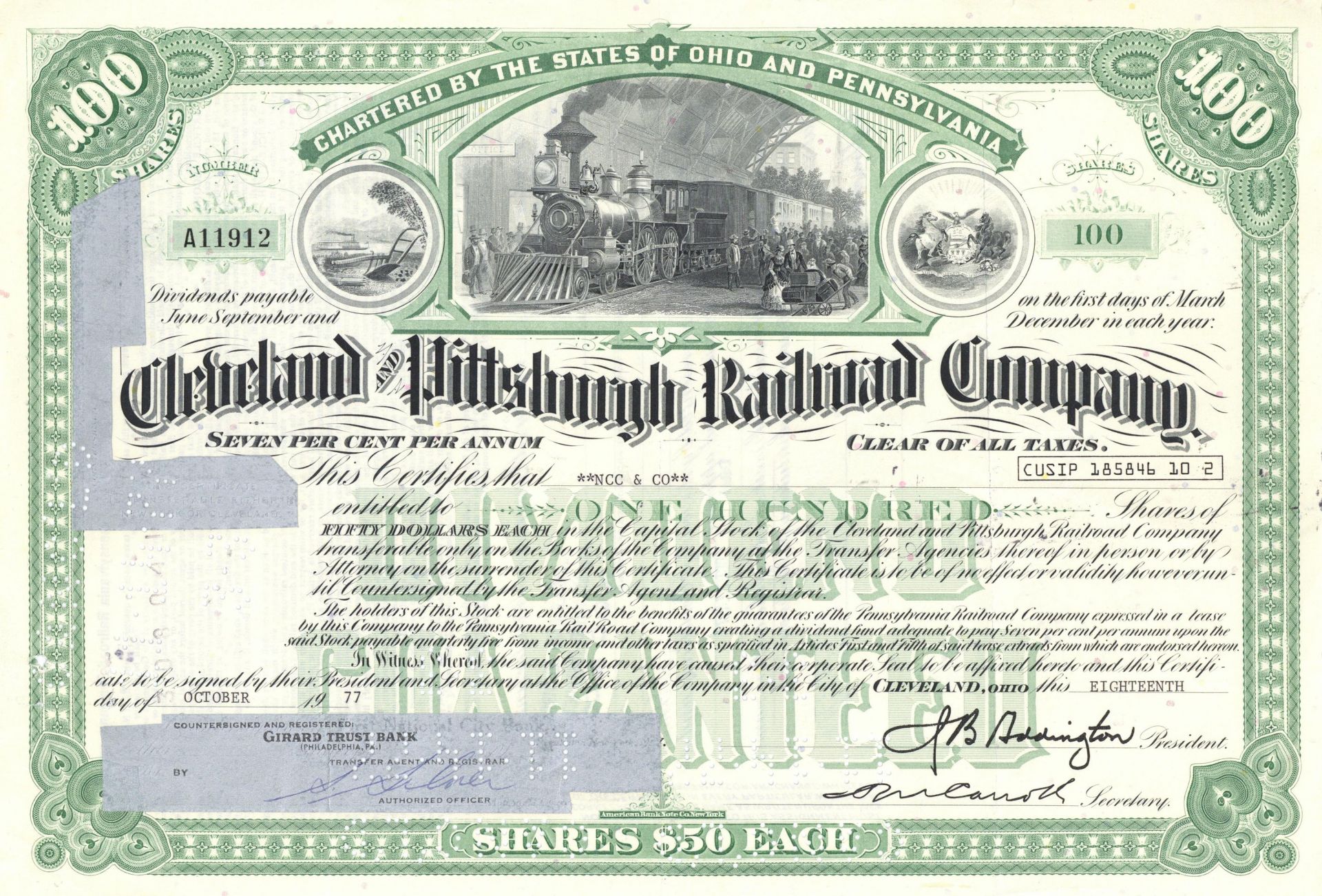
Pennsylvania
Railroad Stock. Triple vignette of a steam locomotive in center. Also scenes at right and left of riverboat and horses. American Bank Note Co. Elaborate borders.
The Cleveland Line is a railway corridor that is owned and operated by Norfolk Southern Railway (NS) in the states of Ohio and Pennsylvania. This line extends from Rochester, Pennsylvania, to Cleveland, Ohio, following the path of a former Pennsylvania Railroad route. Amtrak's Capitol Limited utilizes the Cleveland Line between Cleveland and Alliance, with both eastbound and westbound services scheduled during the midnight and early morning hours. From its starting point in Rochester, the line proceeds westward, tracing the Ohio River between Beaver, Pennsylvania, and Yellow Creek, Ohio, before turning northwest toward Cleveland. Along its route, the line intersects with the Fort Wayne Line at Alliance, Ohio. At this junction, the majority of trains transition from the Fort Wayne Line to the Cleveland Line in order to access the Chicago Line in Cleveland. Continuing northwest from Alliance, the line passes through various locations, including Ravenna, Hudson, and Maple Heights, before ultimately merging with the Chicago Line in downtown Cleveland.
The Cleveland and Pittsburgh Railroad was established in 1836, following public demand for a railway connection between Cleveland and Pittsburgh. The construction of this railway was finalized in 1852, which included additional branches extending to Akron, Ohio, and Wheeling, West Virginia. In 1871, the C&P entered into a 99-year lease with the Pennsylvania Railroad, thereby granting the PRR access to Cleveland. During the tenure of the Pennsylvania Railroad, the line primarily facilitated the transport of coal and minerals from the Ohio River Valley to Cleveland. In 1968, the Pennsylvania Railroad merged with its long-standing competitor, the New York Central Railroad, to create the Penn Central Transportation Company. This merger ultimately proved unsuccessful, leading to the Penn Central's bankruptcy declaration by 1970. In response, Conrail was established in 1976 to manage the remnants of several bankrupt railroads, including the Penn Central. By 1981, Conrail had transformed into a profitable entity, aided by the Staggers Rail Act of 1980. During this period, Conrail initiated upgrades to the former C&P line between Alliance and Cleveland, preparing it to accommodate increased train traffic. The company also redirected Chicago-bound trains that had previously utilized the Fort Wayne Line to the Chicago Line, using the Cleveland Line as a connector. The upgrades were completed, allowing Conrail to reroute a significant portion of Chicago-bound traffic from Pittsburgh to connect with the former New York Central mainline in Cleveland. Following the 1999 split of Conrail between CSX Transportation and Norfolk Southern, ownership of the line transferred to Norfolk Southern.
A stock certificate is issued by businesses, usually companies. A stock is part of the permanent finance of a business. Normally, they are never repaid, and the investor can recover his/her money only by selling to another investor. Most stocks, or also called shares, earn dividends, at the business's discretion, depending on how well it has traded. A stockholder or shareholder is a part-owner of the business that issued the stock certificates.




Ebay ID: labarre_galleries