


Atlantic and Pacific Railroad Co. - 1887 dated $1,000 Uncanceled Railway Gold Bond (Uncanceled)
Inv# RB5164 Bond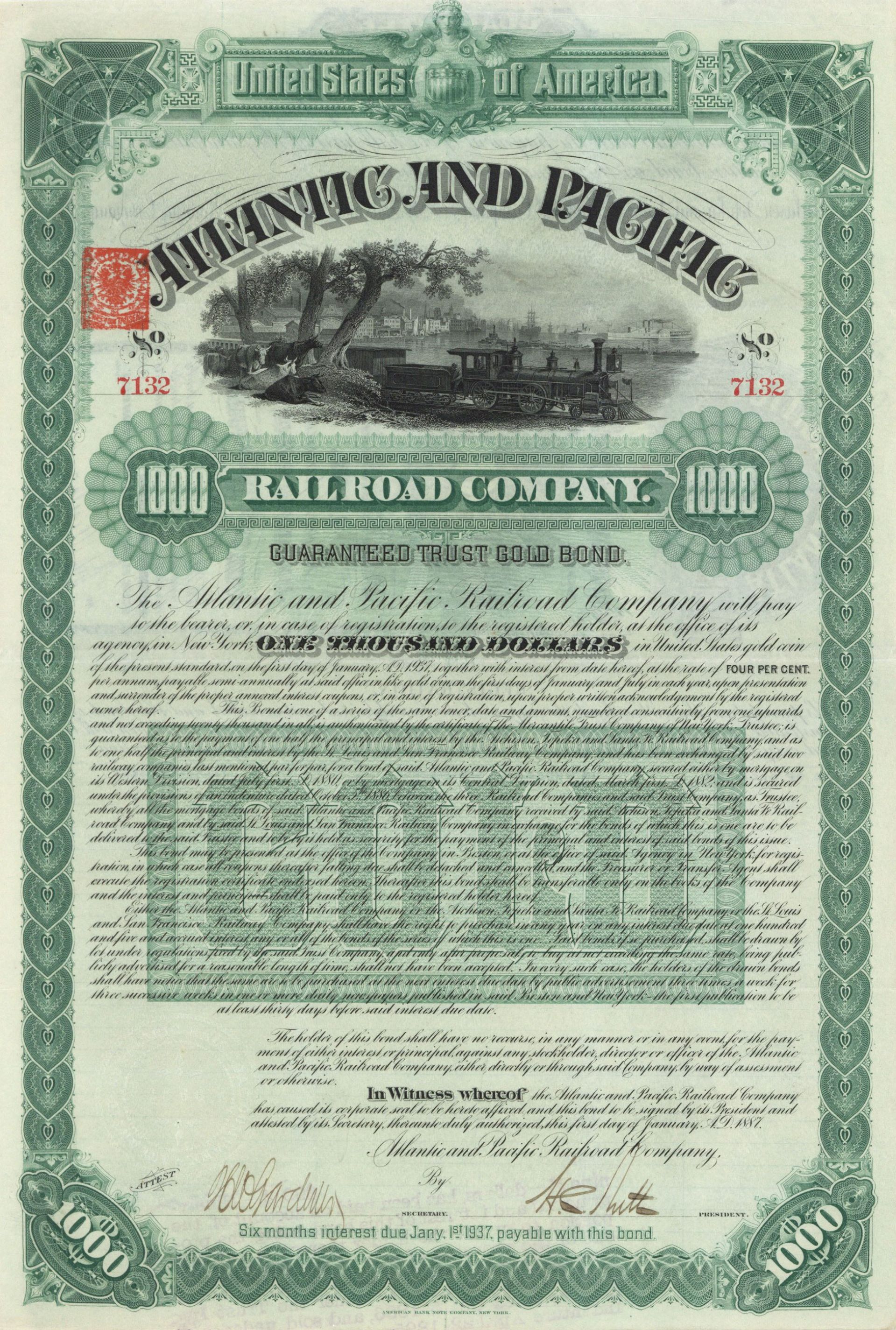
Santa Fe, ever the innovator, was a pioneer in intermodal freight service. This enterprise, at times, included a tugboat fleet and a short-lived airline, the Santa Fe Skyway. Additionally, a bus line enabled the company to extend passenger transportation to areas not accessible by rail, while ferry boats on the San Francisco Bay facilitated travelers’ journeys to the Pacific Ocean. The Atchison, Topeka and Santa Fe Railway officially ceased operations on December 31, 1996, when it merged with the Burlington Northern Railroad to form the Burlington Northern and Santa Fe Railway.
The Atlantic and Pacific Railroad, a U.S. railroad, owned or operated two separate segments. One segment connected St. Louis, Missouri, with Tulsa, Oklahoma, while the other connected Albuquerque, New Mexico, with Southern California. In 1866, the railroad was incorporated by the U.S. Congress as a transcontinental railroad that aimed to connect Springfield, Missouri, and Van Buren, Arkansas, with California. However, the central portion of the railroad was never constructed, and the two halves later became part of the St. Louis-San Francisco Railway and Atchison, Topeka, and Santa Fe Railway systems. These systems are now merged into the BNSF Railway. The A&P’s earliest predecessor was the Pacific Railroad, established by the Missouri General Assembly in 1849. Its primary objective was to connect St. Louis to a location south of Kansas City, spanning the entire state. In response to a federal law enacted in 1852, which granted public lands to Missouri for the construction of two cross-state railroads, the state amended the 1849 Pacific Railroad law in December 1852.
This amendment included the addition of a Southwest Branch, which was designated to receive the allocated grants. The new branch, as defined by state law, was situated south of the Osage River. It commenced its journey from Franklin, Missouri, (now known as Pacific) on the main line and proceeded west-southwesterly across the state. Construction of the 71-mile (114 km) stretch from Franklin to Dillon was completed in 1860, and an additional 6 miles (9.7 km) to Rolla were opened in 1861. The company had also graded 12 miles (19 km) more to Arlington, but after defaulting on bonds issued for the branch, the state seized the road from Franklin to Rolla and the incomplete roadbed to Arlington in March 1866. In June, the property was sold for $1.3 million to explorer and politician John C. Frémont. Frémont subsequently reorganized the land as the Southwest Pacific Railroad in September. (It’s worth noting that the main line of the Pacific Railroad was not sold and later became the Missouri Pacific Railroad.) In July 1866, Congress passed a law that incorporated the Atlantic and Pacific Railroad under the control of Frémont and associates. The railroad was granted the authority to construct a line near the 35th parallel, extending from Springfield, Missouri, westward to the Pacific Ocean. Additionally, a branch was permitted to be built from Van Buren, Arkansas. In exchange for the completion of the railroad by 1878, the company was awarded land grants along its route. Similar conditions were applied to the Southern Pacific Railroad of California, which was granted the permission to build a branch that would connect to the A&P near the eastern border of the state.
In January 1867, the A&P acquired the Southwest Pacific Railroad. That same year, rails were laid on the grade to Arlington. However, the Southwest Pacific Railroad defaulted on its payments, leading the state of Missouri to seize the property once again in June 1867. In July 1868, the property was sold to a new South Pacific Railroad. The ownership of the A&P was also transferred to the new owners, including Clinton B. Fisk of St. Louis.
In 1870, the A&P completed an additional 164 miles (264 km) of track from Pierce City to Seneca, along with 39 miles (63 km) of grading to Seneca on the state line. In October of that year, the South Pacific Railroad sold its property to the A&P. The A&P then laid rails to Neosho that year and to Seneca, extending further to Vinita, Oklahoma, in 1871. In June 1872, the A&P leased the Pacific (later Missouri Pacific) Railroad, which operated a line to Kansas City and several branches, including several into Kansas.
The A&P’s sole branch, a 1.5-mile (2.4 km) track to a mine near Granby, Missouri, was constructed in 1875. However, this incarnation faced similar financial challenges. In November 1875, its Missouri division, spanning from Franklin to Seneca, was placed under receivership, and the Pacific Railroad lease was terminated. In response, the owners of the A&P incorporated the St. Louis and San Francisco Railway in September 1876. They promptly acquired the property of the Missouri division and secured a lease on the Central division, which extended from Seneca to Vinita. Furthermore, the lease included extensions beyond Vinita for 64 miles (103 km) to Tulsa (1882), 4 miles (6.4 km) to Red Fork (1885), and 10 miles (16 km) to Sapulpa (1886). Notably, the SL&SF also constructed a direct line into St. Louis in 1883, eliminating its reliance on the Missouri Pacific for access to that city. In January 1880, the Southern Pacific Railroad (SL&SF) and the Atchison, Topeka and Santa Fe Railroad (AT&SF) reached an agreement. The AT&SF, which had recently entered New Mexico from the north, would jointly control the Atchison, Pacific and Santa Fe Railroad (A&P). The SL&SF would continue to operate the Central division, while a new Western division would begin on the AT&SF at Isleta, New Mexico and head west to meet the Southern Pacific at Needles, California. Construction commenced that year and reached Kingman, Arizona in 1882. The SP simultaneously began building a branch from Mojave, California, that same year, extending east to Needles, where the two railroads met on August 9, 1883. In August 1884, the A&P, which was essentially an operating subsidiary of the AT&SF, leased the line from the SP. In November 1885, the AT&SF-owned California Southern Railroad completed its line over Cajon Pass to the SP’s Needles branch at Barstow, providing the AT&SF with access to the coast. In addition to its lease of the SP to Mojave, the A&P also operated via trackage rights over the AT&SF from Isleta to Albuquerque. The AT&SF acquired control of the SL&SF in 1890, but both companies entered receivership in December 1893 following the Panic of 1893. The A&P followed suit in January 1894. In June 1897, the Western division of the road was sold to the newly formed AT&SF subsidiary, Santa Fe Pacific Railroad. The remaining Central division was sold under foreclosure to the reorganized SL&SF, which was once again independent of the AT&SF, in December 1897, effectively ending the A&P’s existence.
Through the Santa Fe Pacific, the AT&SF acquired trackage rights over the SP’s Tehachapi Pass line in January 1899, gaining access to the Central Valley of California and the San Francisco Bay Area. The Santa Fe Pacific left the SP at Kern Junction, where the San Francisco and San Joaquin Valley Railway, another AT&SF subsidiary, began operations. The railroad operated into Bakersfield via SF&SJV trackage. In July 1902, the AT&SF acquired the railroad property of the Santa Fe Pacific. In December 1911, the non-operating subsidiary of the AT&SF, California, Arizona and Santa Fe Railway, purchased the leased Southern Pacific line between Mojave and Needles. However, the Santa Fe Pacific Railroad retained ownership of its land grants from the A&P. As of 2007, the Santa Fe Pacific continued to exist as a subsidiary of the Burlington Northern Santa Fe Corporation, the successor to the AT&SF. The gap across Oklahoma, Texas, and New Mexico was eventually filled in 1904 when the Arkansas Valley and Western Railway, an SL&SF subsidiary, completed its line from Tulsa to Avard, Oklahoma, on the AT&SF’s line through the Texas Panhandle. In 1995, the line was joined under one company when the AT&SF merged with SL&SF’s successor, Burlington Northern Railroad, to form the BNSF Railway. The BNSF Railway remains a mainline. Networks are being developed in many parts of the world.
A bond is a document of title for a loan. Bonds are issued, not only by businesses, but also by national, state or city governments, or other public bodies, or sometimes by individuals. Bonds are a loan to the company or other body. They are normally repayable within a stated period of time. Bonds earn interest at a fixed rate, which must usually be paid by the undertaking regardless of its financial results. A bondholder is a creditor of the undertaking.




Ebay ID: labarre_galleries