


Andrew Carnegie Trust - Baltimore and Ohio Railroad Co. - $10,000 Bond
Inv# RB7229 Bond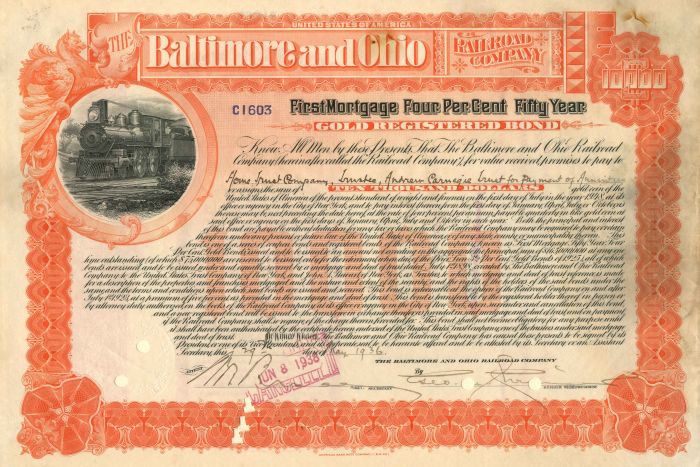
$10,000 4% Gold Bond printed by American Bank Note Company. Issued to Andrew Carnegie Trust. Some staining.
Andrew Carnegie, born on November 25, 1835, in Dunfermline, Scotland, and emigrated to the United States with his parents in 1848 at the tender age of 12, made significant strides in the industrial world. He became a prominent figure in the American steel industry, leading its expansion in the late 19th century. Carnegie’s wealth grew exponentially, and he eventually became one of the richest Americans in history.
Beyond his business acumen, Carnegie also dedicated himself to philanthropy. During the final 18 years of his life, he generously donated approximately $350 million (equivalent to roughly $5.2 billion in 2020) to various charitable organizations, foundations, and universities. This remarkable act of generosity resulted in almost 90 percent of his fortune being allocated to charitable causes.
Carnegie’s influential 1889 article titled “The Gospel of Wealth” inspired the wealthy to use their wealth for the betterment of society. He advocated for progressive taxation and an estate tax, and his words ignited a wave of philanthropy that had a profound impact on the United States and the British Empire.
Carnegie’s journey began in Dunfermline, Scotland, where he worked as a telegrapher. By the 1860s, his investments in railroads, railroad sleeping cars, bridges, and oil derricks had significantly contributed to his wealth. As a bond salesman, he further amassed his fortune by raising money for American enterprises in Europe.
Carnegie’s most notable achievement was the establishment of Pittsburgh’s Carnegie Steel Company. He sold this company to J. P. Morgan in 1901 for a staggering $303,450,000. The Carnegie Steel Company later became the foundation of the U.S. Steel Corporation, a prominent player in the steel industry. After selling Carnegie Steel, Carnegie surpassed John D. Rockefeller as the richest American, a title he held for several years.
Carnegie dedicated the rest of his life to large-scale philanthropy, particularly focusing on local libraries, world peace, education, and scientific research. Using his wealth from business, he constructed Carnegie Hall in New York City, established the Peace Palace, and founded the Carnegie Corporation of New York, Carnegie Endowment for International Peace, Carnegie Institution for Science, Carnegie Trust for the Universities of Scotland, Carnegie Hero Fund, Carnegie Mellon University, and the Carnegie Museums of Pittsburgh, among other notable institutions.
A bond is a document of title for a loan. Bonds are issued, not only by businesses, but also by national, state or city governments, or other public bodies, or sometimes by individuals. Bonds are a loan to the company or other body. They are normally repayable within a stated period of time. Bonds earn interest at a fixed rate, which must usually be paid by the undertaking regardless of its financial results. A bondholder is a creditor of the undertaking.




Ebay ID: labarre_galleries