


Abraham Lincoln signed Appointment to Edward L. Kingsbury of Maine - 1863 dated Presidential Autograph
Inv# AG2089A Autograph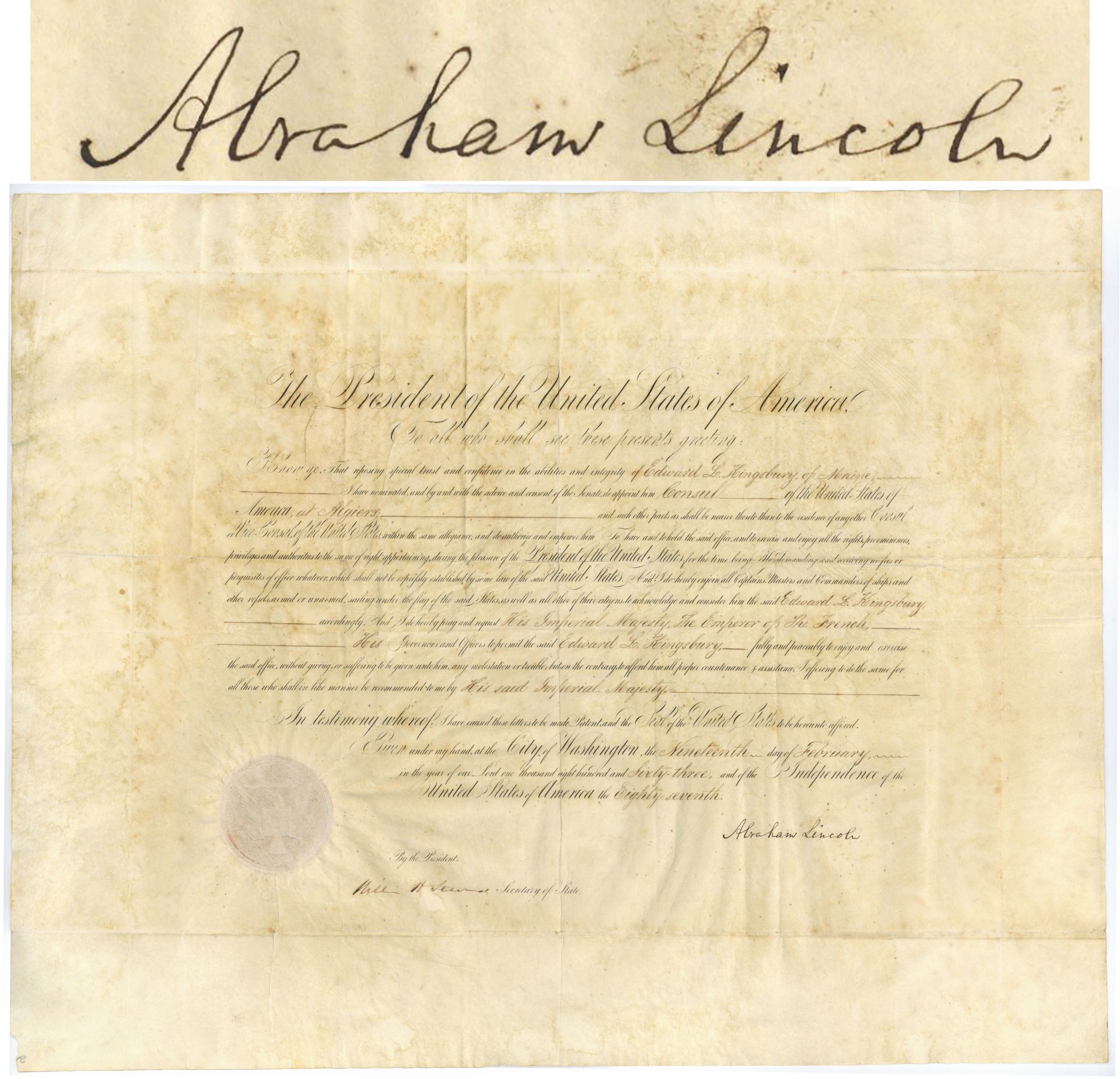
Signed by Abraham Lincoln and William H. Seward.
Abraham Lincoln, (1809-1865) the 16th President of the United States, rose from humble beginnings to become one of America’s most influential figures. Born in a log cabin in Hardin County, Kentucky, in 1809, he was largely self-educated, cultivating a deep love for reading and the law. After relocating to Illinois, he worked various jobs, including storekeeping, surveying, and postmaster, before entering politics and establishing a successful legal career. His reputation for integrity earned him the nickname “Honest Abe,” and his sharp intellect and powerful oratory skills eventually propelled him into the national spotlight during his renowned debates with Stephen A. Douglas.
Elected to the presidency in 1860, Lincoln faced the most significant existential threat to the United States—the American Civil War. His primary objective was the preservation of the Union, but his legacy is most defined by his moral transformation regarding slavery, culminating in the Emancipation Proclamation of 1863. Through his leadership and iconic speeches, such as the Gettysburg Address, he redefined the American purpose as a struggle for “a new birth of freedom.” Tragically, his life was cut short by an assassin’s bullet in April 1865, just days after the Confederate surrender, solidifying his status as a martyr and a symbol of national unity.
William H. Seward (1801–1872), a titan of 19th-century American politics, is best remembered for his indomitable spirit and his pivotal role in the antislavery movement. Born in Florida, New York, Seward rose to prominence as a lawyer before serving as the Governor of New York and later as a U.S. Senator. He championed the “higher law” doctrine, asserting that moral law dictated the abolition of slavery irrespective of constitutional protections. Although he was the frontrunner for the Republican presidential nomination in 1860, he ultimately lost to Abraham Lincoln. Demonstrating remarkable pragmatism and grace, Seward joined Lincoln’s cabinet as Secretary of State, where he became one of the President’s closest advisors and a key architect of Union diplomacy during the Civil War.
Seward’s legacy is perhaps most defined by his visionary—and at the time, controversial—expansionist foreign policy. In 1867, he orchestrated the purchase of Alaska from Russia for a mere $7.2 million. While critics derided the acquisition as “Seward’s Folly” or “Seward’s Icebox,” the deal proved to be a geopolitical triumph that secured vast natural resources and a strategic foothold in the Pacific. Throughout his career, Seward endured a brutal assassination attempt on the same night Lincoln was killed and continued to serve as Secretary of State under Andrew Johnson. He passed away in 1872, leaving behind a reputation as a staunch defender of the Union and a statesman who transcended the limitations of his own era.
Edward L. Kingsbury (1842–1912) was a prominent figure in 19th-century Maine, primarily recognized for his diverse career as a veteran, educator, and civic leader. Born in the town of Brewer, Kingsbury’s early life was shaped by his commitment to duty during the American Civil War. He enlisted in the 17th Maine Volunteer Infantry, where he distinguished himself with his service. His experiences on the battlefield instilled in him a character of resilience and discipline that would later guide his civilian life. Upon returning to Maine after the war, he dedicated himself to the betterment of his community, utilizing his military background to instill values of order and patriotism in the younger generation.
In his post-war years, Kingsbury became deeply integrated into the professional and social fabric of Bangor and Brewer. He was a prominent member of the Grand Army of the Republic (GAR), a significant veterans’ organization where he devoted himself to supporting his fellow soldiers and preserving the history of their service. Beyond his veteran advocacy, he was highly regarded for his contributions to local commerce and his involvement in fraternal organizations, which were the backbone of Maine’s social life during that era. Kingsbury’s legacy stands as a testament to the “citizen-soldier” ideal, representing a generation of Maine men who transitioned from the chaos of war to the quiet, steadfast building of a burgeoning American state.




Ebay ID: labarre_galleries