


Trans-Beacon Corp. - 1966-1971 dated RKO Pictures Connected Stock Certificate - Great History
Inv# GS5068 Stock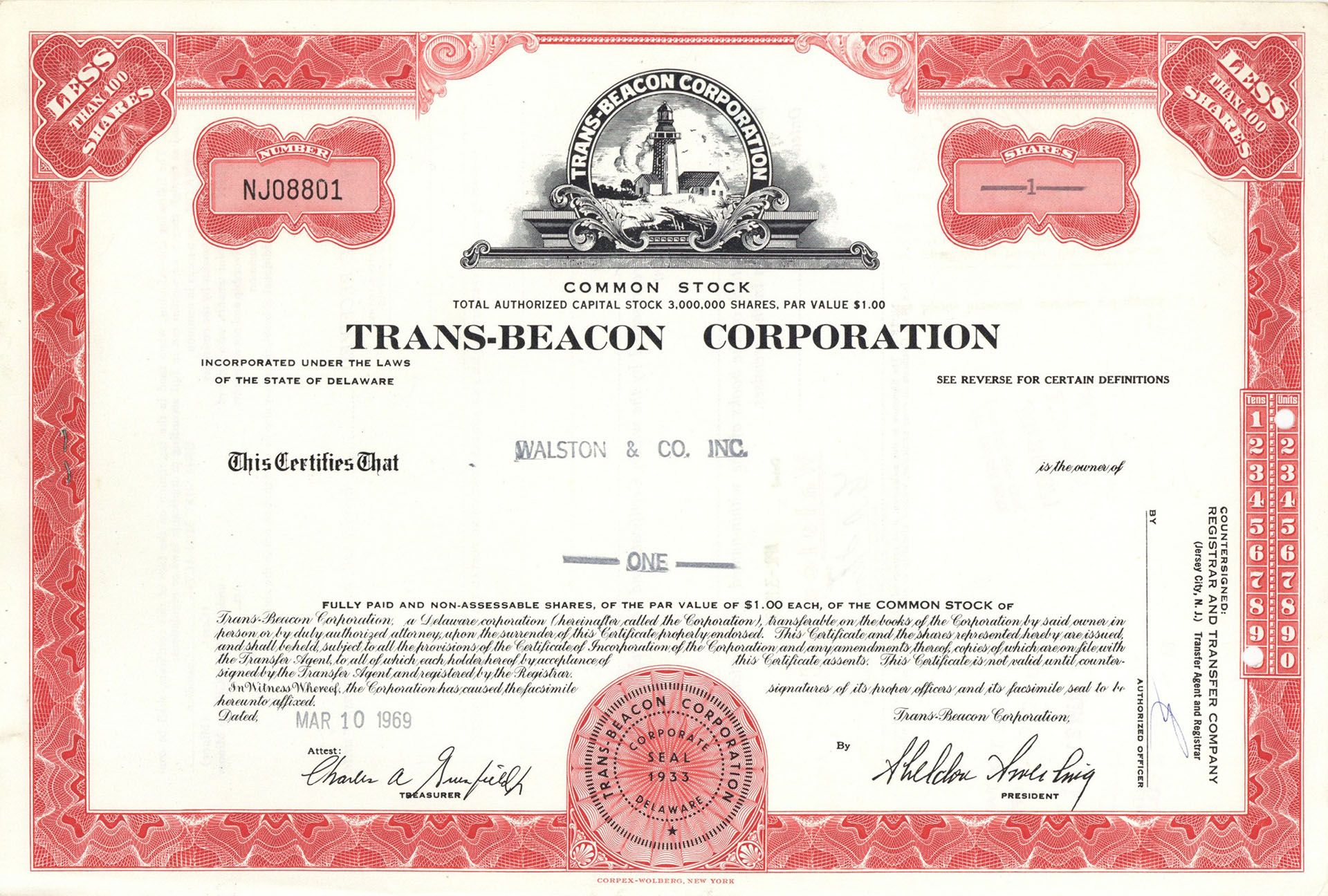
Stock printed by Corpex-Wolberg, New York. Orange or Red Available. Please specify color.
RKO Radio Pictures Inc., often referred to as RKO Pictures or simply RKO, was an American film production and distribution entity, recognized as one of the "Big Five" film studios during Hollywood's Golden Age. The company was established following the consolidation of the Keith-Albee-Orpheum theater chain and Joseph P. Kennedy's Film Booking Offices of America studio under the auspices of the Radio Corporation of America (RCA) in October 1928. RCA executive David Sarnoff orchestrated the merger to establish a market for the company's sound-on-film technology, RCA Photophone, and production commenced under the RKO name (an abbreviation of Radio-Keith-Orpheum) in early 1929. Two years later, another Kennedy enterprise, the Pathé studio, was integrated into the operation. By the mid-1940s, RKO was under the control of investor Floyd Odlum.
In 1971, the television—and subsequently, video—rights to a majority of the RKO film library were auctioned off after the rights holders, TransBeacon (a corporate successor of C&C Television), declared bankruptcy. The auctioned rights were divided between United Artists (UA) and Marian B. Inc. (MBI). In 1984, MBI established a subsidiary, Marian Pictures Inc. (MBP), to which it assigned its portion of the RKO rights. Two years later, GenCorp's subsidiaries, RKO General and RKO Pictures, reacquired the rights previously held by MBP. Meanwhile, United Artists had been purchased by MGM. In 1986, MGM/UA's extensive library, which included its RKO film negatives and rights, was acquired by Turner Broadcasting System for its newly formed Turner Entertainment division. When Turner revealed plans to colorize ten of the RKO films, GenCorp opposed this, alleging copyright infringement, which resulted in both parties initiating lawsuits. During RKO Pictures' brief Wesray period, Turner obtained numerous distribution rights that had reverted to RKO through MBP, along with both the theatrical rights and the television rights that had originally been withheld from C&C for the cities where RKO owned stations. The new proprietors of RKO also permitted Turner to proceed with the colorization of the library.
A stock certificate is issued by businesses, usually companies. A stock is part of the permanent finance of a business. Normally, they are never repaid, and the investor can recover his/her money only by selling to another investor. Most stocks, or also called shares, earn dividends, at the business's discretion, depending on how well it has traded. A stockholder or shareholder is a part-owner of the business that issued the stock certificates.




Ebay ID: labarre_galleries