


Sea Island Co. - Cotton - 1865 South Carolina, Georgia, & Florida Stock Certificate - Great History!
Inv# GS1228A Stock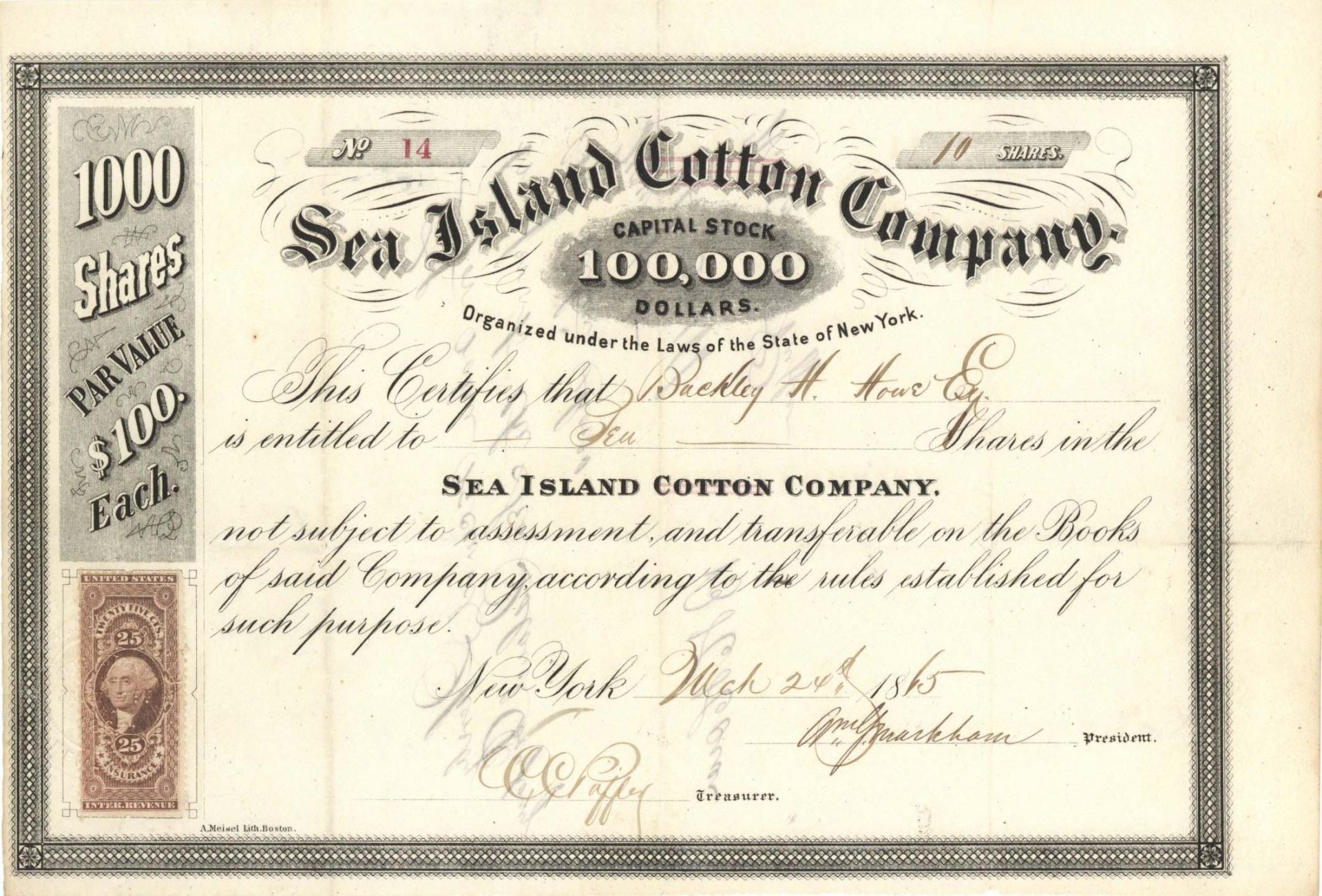
Georgia
New York
South Carolina
Stock. No vignette, but ornate title & so rich in history. 25 cents Washington revenue stamp! Civil War era dated!
Sea island cotton, a historical market class, was actively marketed from 1790 to 1920. It was cultivated on the islands off the coasts of South Carolina, Georgia, and Florida. Initially, sea island cotton was an important market class in Europe, where it faced little competition from cottons with similar characteristics. However, this competition was interrupted by the U.S. Civil War, which disrupted trade.
The origins of sea island cotton have been a subject of considerable controversy. Despite this, developing the market class involved creating cultivars that were productive in the sea islands and developing a distinct product from other types of cotton. Additionally, it required at least some producers and consumers to agree that “sea island” was a useful category.
One of the challenges in explaining the development of long-fiber cotton that thrived in the sea islands was that the cotton in those islands came from the West Indies, an area where all cultivated cotton was short-fiber (by today’s standards) and required a long growing season. Frost killed the plants before they had a chance to produce seeds, making it impossible to develop a distinctive cotton in the sea islands using hybridization or selection methods.
A stock certificate is issued by businesses, usually companies. A stock is part of the permanent finance of a business. Normally, they are never repaid, and the investor can recover his/her money only by selling to another investor. Most stocks, or also called shares, earn dividends, at the business's discretion, depending on how well it has traded. A stockholder or shareholder is a part-owner of the business that issued the stock certificates.




Ebay ID: labarre_galleries