


Piggly Wiggly Western States Co. - 1920's dated Supermarket Chain Stock Certificate
Inv# GS1295 Stock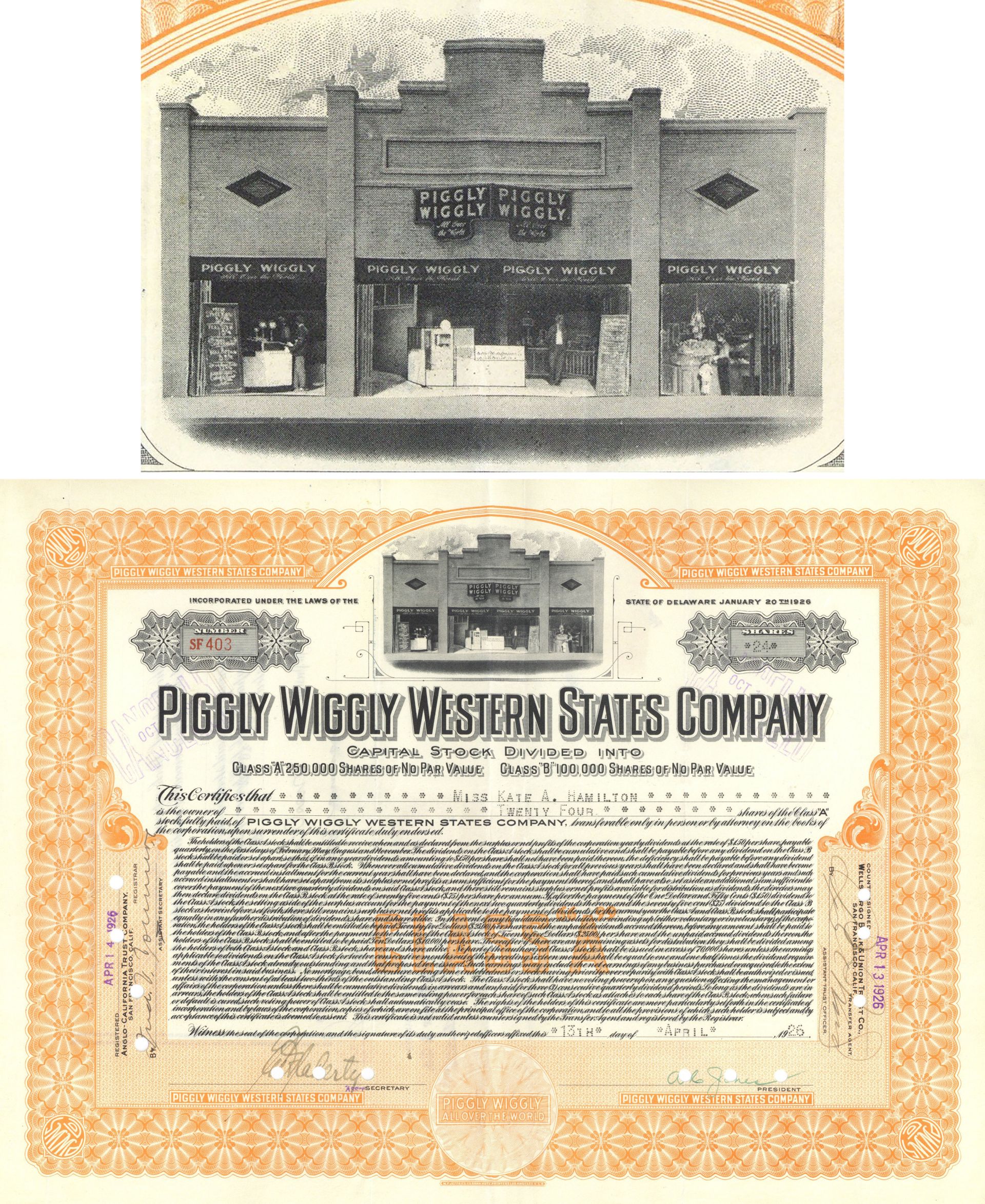
State(s):
Delaware
Years:
1926
Color:
Orange and Black
Large size Stock with vignette of the Piggly Wiggly storefront printed by W.P. Jeffries Banknote Printers Los Angeles, CA. Stock measures 14 1/4" x 10 1/2".
While Piggly Wiggly is most strongly associated with the Southern and Midwestern United States today, the pioneering self-service grocery chain did have a significant, albeit somewhat complex, presence in the Western states during its early decades. The initial success of Clarence Saunders' patented self-service format in Memphis, Tennessee, led to rapid franchising across the country. By the early 1920s, Piggly Wiggly stores had opened in cities throughout the West, including Seattle, San Diego, and Spokane, with local companies acquiring franchises for specific regions. These western operations were often separate entities, paying licensing fees to the parent company.
One notable example was Western States Piggly Wiggly, formed in 1926 through a merger of branches in Utah and California, which had already been expanding into Washington and Oregon. This Western expansion saw Piggly Wiggly stores competing and often co-existing with other burgeoning grocery chains. However, the landscape of the grocery industry was highly dynamic in the 1920s and 30s. Eventually, many of these Western Piggly Wiggly franchises were acquired by larger, consolidating chains. For instance, Safeway acquired most of the West Coast Piggly Wiggly stores around 1931, including those that had been part of the Western Piggly Wiggly and MacMarr Stores merger. This marked a shift in the brand's geographical footprint, solidifying its primary presence in the Southeast and Midwest, where it continues to operate today through independent franchisees under the Piggly Wiggly, LLC umbrella.
Condition:
Excellent
A stock certificate is issued by businesses, usually companies. A stock is part of the permanent finance of a business. Normally, they are never repaid, and the investor can recover his/her money only by selling to another investor. Most stocks, or also called shares, earn dividends, at the business's discretion, depending on how well it has traded. A stockholder or shareholder is a part-owner of the business that issued the stock certificates.
Item ordered may not be exact piece shown. All original and authentic.




Ebay ID: labarre_galleries