

Uncut Sheet of 4 State of Louisiana Bonds known as 'Baby Bonds' - 1874-78 dated Series B Uncut Sheet of 4 Bonds - Great History
Inv# GB5065B Bond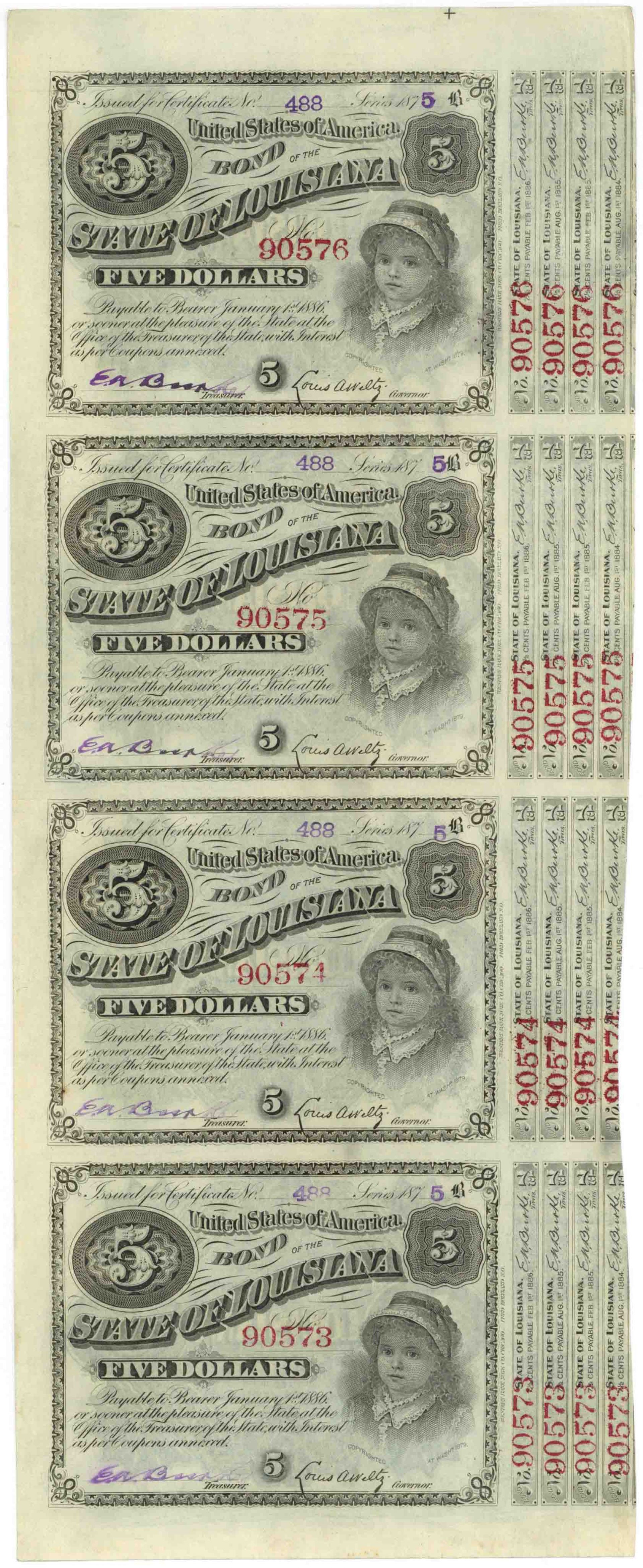
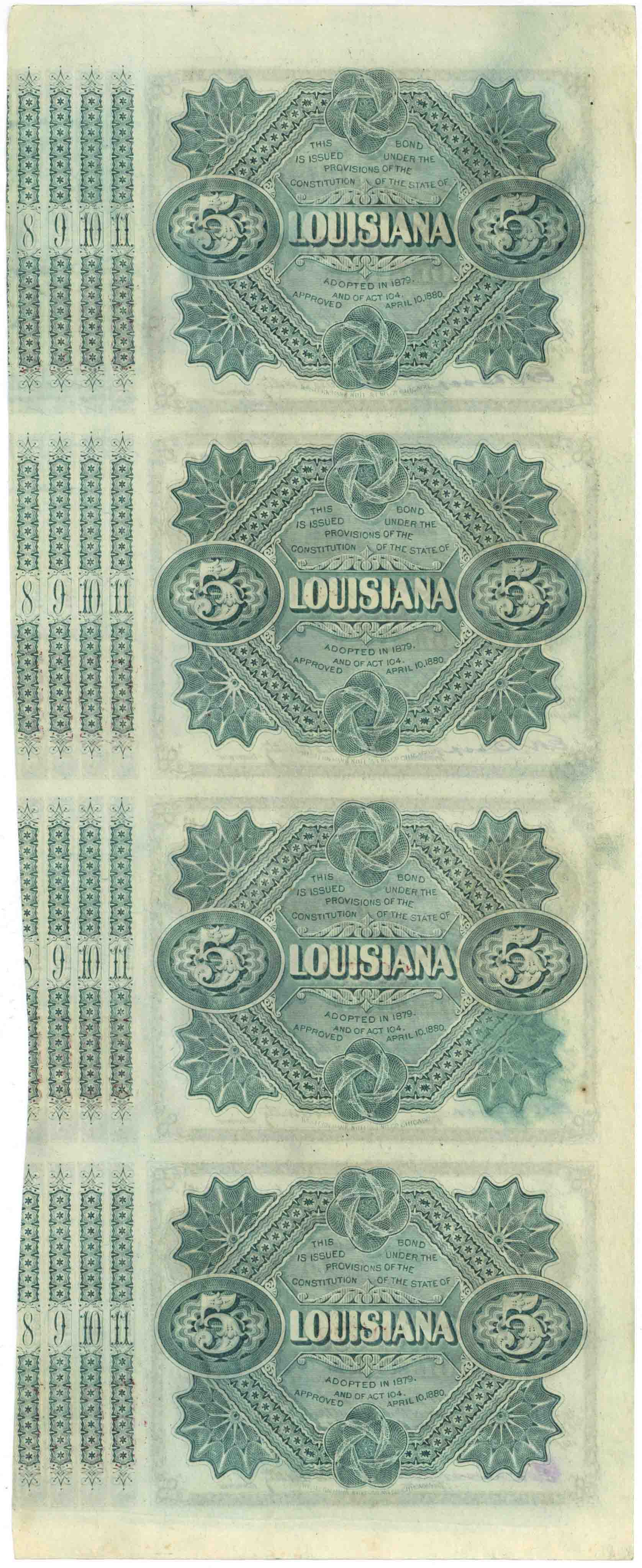
Series B $5 Dollar State of Louisiana Baby Bonds. Uncut Sheet of 4 Bonds.
These 1870’s bonds come with an interesting history. At the close of the Civil War, the federal government imposed a large tax on state banknotes. The state of Louisiana issued small bank notes and disguised them as interest-bearing bonds. These $5.00 “Baby Bonds” have a picture of a baby on the front. Thus, the state avoided the tax. Everyone knew that they were worth the same as federally approved currency, so they were used throughout the state.
In the 1880’s, Louisiana’s State Treasurer, Edward Burke or Burk, had used the original plates to reprint these bonds with identical numbers. About $300,000 in counterfeit Baby Bonds were discovered in his safe deposit box. He then fled to South America. These genuine $5.00 Baby Bonds each have their own serial number and Ed Burke’s facsimile signature. They make a great addition to any collection because of their size (5.5” x 3.25”), baby denomination, baby 7.5¢ coupons, and charming vignette of a baby.
Edward Austin Burke, also known as Burk (September 13, 1839 – September 24, 1928), served as the Democratic State Treasurer of Louisiana in the aftermath of Reconstruction. Following the revelation of misappropriations involving state treasury funds, Burke sought refuge in Honduras. During his time in Honduras, he became a significant landowner and occupied various governmental roles within the nationalized railway systems of the country. He lived in exile until his passing nearly forty years later at the age of 89.
Honduras was one of three Central American countries that participated in the exposition. Although their display was relatively modest compared to others, it was distinguished by a personal visit to the exposition by Honduran President Luis Bográn. During this visit, Bográn’s host was Burke. Bográn was particularly impressed by Burke’s character. The two developed a close friendship. Bográn sought an individual to promote the wealth of natural resources that Honduras possessed and offered Burke two substantial mining concessions along the Jalán and Guayape rivers in exchange for Burke’s commitment to assist in constructing an industrial school in Tegucigalpa, Honduras’ capital. Burke accepted this offer and visited Honduras on at least two occasions between 1886 and 1888. However, in 1888, a reform-minded opposition emerged and successfully ousted Burke.
In response to his previous role as state treasurer, Burke redirected the time he had allocated to develop his mining endeavors. In 1889, Burke embarked on a journey to London with the objective of securing funding for a contemporary mining operation. During his stay in London, his successor, William Henry Pipes, uncovered substantial discrepancies in the amount of funds available within the state treasury. Consequently, Burke emerged as a primary suspect in the embezzlement case. From London, Burke vehemently denied these allegations and asserted his intention to return to New Orleans to confront his accusers. Upon reviewing the available evidence, a grand jury issued nineteen indictments against Burke. The evidence presented indicated that Burke had neglected to destroy state bonds that had been redeemed and subsequently issued additional baby bonds without the requisite authorization. The estimated value of the missing treasury funds ranges from $64,000 to $2 million. In early December, Burke made the decision to forego his return to New Orleans and was subsequently personally received by President Bográn in Tegucigalpa, Honduras. Notably, Burke arrived in Honduras without any financial losses, as he had successfully secured financing of $8 million for his mining venture. Notably, apprehending Burke posed no legal impediment, as Honduras had not yet formalized extradition treaties with the United States.
Burke’s financial fortunes in Honduras were not favorable. He faced numerous financial crises in both London and Paris, leading to investor withdrawals. Additionally, he encountered inclement weather and regime changes. In November 1893, Burke supported the losing faction in a series of military skirmishes against Policarpo Bonilla. Burke and Domingo Vásquez were compelled to flee to neighboring El Salvador. Eventually, Burke reconciled with Bonilla and returned. Coincidentally, during this period of political upheaval, opponents of the Louisiana Lottery successfully persuaded Congress to prohibit the interstate transportation of lottery tickets or lottery advertisements. The U.S. Supreme Court subsequently upheld this position. Instead of ceasing operations, the Louisiana Lottery opted to relocate its operations from New Orleans to Honduras. The extent to which Burke exerted any influence in guiding the Louisiana Lottery to relocate to Honduras remains uncertain.
In June 1904, Burke assumed the role of assistant superintendent and auditor for the Honduras Interoceanic Railway, a government-owned railroad. He held this position until August 1906. Subsequently, from 1912 to 1926, Burke occupied various positions within the National Railway of Honduras, commonly referred to as El Ferrocarril Nacional de Honduras, another nationalized railroad. In February 1926, Burke’s associates in New Orleans successfully dismissed all of his indictments. Despite his acquittal, Burke chose to remain in Honduras. In 1928, Burke was present to greet Charles Lindbergh, who was embarking on a goodwill flight through Central America. This was not Burke’s initial encounter with a renowned aviator. In 1919, Burke inadvertently employed local Lisandro Garay as a driver. Garay would subsequently achieve fame as an aviator in his own right, earning the moniker “Honduran Lindbergh.”
Instead of shutting down, the Louisiana Lottery decided to transfer its operations from New Orleans to Honduras. Very little is known, if Burke had any influence in steering the Louisiana Lottery to move to Honduras.
In June 1904, Burke accepted a position as the assistant superintendent and auditor of the Honduras Interoceanic Railway, one of the government's nationalized railroads. He held this position until August 1906. From 1912 to 1926, Burke held various positions within the National Railway of Honduras, also known as El Ferrocarril Nacional de Honduras, another nationalized railroad. In February 1926, Burke's associates back in New Orleans succeeded in nullifying all of his indictments. Even though Burke was vindicated, he decided to remain in Honduras. In 1928, Burke was on hand to greet Charles Lindbergh who was on a goodwill flight through Central America. This was not Burke's first encounter with a famous aviator. In 1919, Burke had unknowingly hired local Lisandro Garay as a driver. Garay would later become famous as an aviator in his own right, picking up the moniker — the "Honduran Lindbergh".
A bond is a document of title for a loan. Bonds are issued, not only by businesses, but also by national, state or city governments, or other public bodies, or sometimes by individuals. Bonds are a loan to the company or other body. They are normally repayable within a stated period of time. Bonds earn interest at a fixed rate, which must usually be paid by the undertaking regardless of its financial results. A bondholder is a creditor of the undertaking.




Ebay ID: labarre_galleries