


Manhattan Market Co. of the City of New York - 1871 dated $500 Bond (Uncanceled)
Inv# GB5611 Bond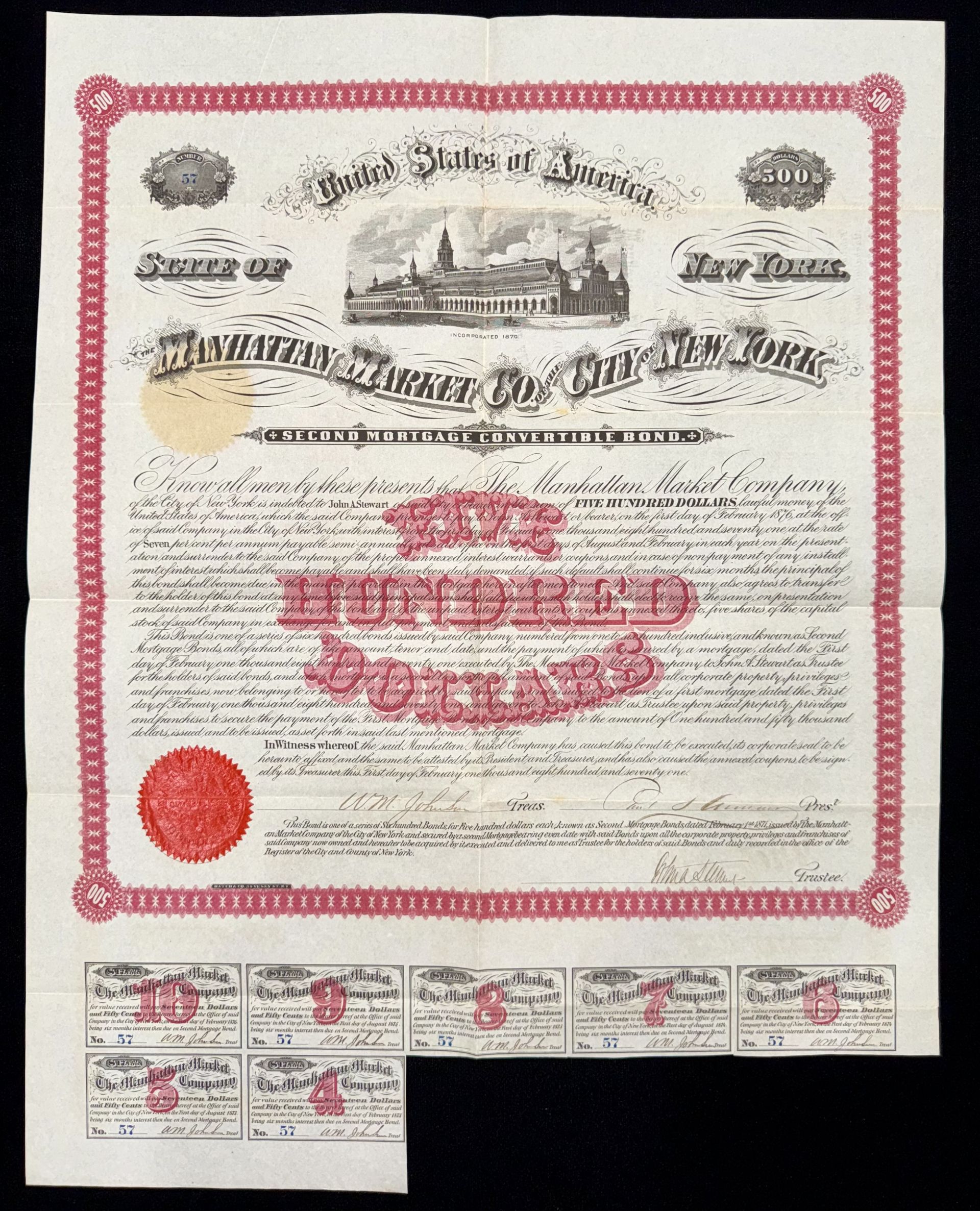
$500 7% Uncanceled Bond printed by Hatch & Co., N.Y. 7 coupons remain. Great color! Rare! Measures 16" wide x 23 3/4" tall. Established in New York in 1871, this large structure measured 800 by 200 feet and was located between 34th and 35th Streets. It has since been demolished.
History from "New York and Its Institutions, 1609-1871" by REV. J. F. RICHMOND, published in 1872. The Manhattan Market Company, which received its charter a year and a half ago, is currently constructing the largest and most impressive market building ever undertaken on the island. This facility is located on the block situated between Thirty-fourth and Thirty-fifth streets, and Eleventh and Twelfth avenues. The main edifice, constructed from iron, stone, and Philadelphia brick, measures 800 feet in length and 200 feet in depth, featuring 800 market stands. The interior boasts a height of 80 feet and is well illuminated; should Washington be relocated, it is likely to become the city's primary wholesale market. The contractors have committed to completing the project by October 1, 1871, with additional developments planned under the company's oversight. In 1859, Philadelphia was experiencing a push to consolidate its city government and eliminate disorder, vagrants, and unpleasant odors that troubled the middle class. As a burgeoning mill and port city, Philadelphia required cleanliness and order; the burgeoning railroad companies, vital to the city's economy, sought access to streets that were obstructed by public markets.
As a result, the city dismantled the prominent High Street Market, and the legislature permitted the establishment of thirteen privately owned market house companies. An additional seven were formed prior to 1862. The structures created by these companies were large and impressive, with stalls inside the market houses initially commanding high rental prices. However, the companies faced significant challenges in maintaining viability. Ineffective management and an oversupply of market houses contributed to the downfall of several firms. Despite the relatively brief existence of many private market companies in Philadelphia, this did not deter other cities from replacing public markets with off-street market houses. By the close of the nineteenth century, the Commonwealth of Pennsylvania had established over 100 private market houses. The era of laissez-faire policies and governmental support for corporations began to influence food distribution. By the 1880s, both private and public markets in the commonwealth had gained a national reputation for their success.
In 1871, the New York Assembly established a private market house known as the Manhattan Market Company in New York City. However, the city's enthusiasm for public markets remained strong. That same year, De Voe, a prominent advocate for public market houses, was appointed as the superintendent of markets, a role he would fulfill for ten years. While the Manhattan Market Company commenced its brief operations, De Voe focused on reforming the management of public markets to ensure their sustainability. Thanks to De Voe's efforts, public markets gained greater significance in New York City compared to Philadelphia. Despite the introduction of private markets in both cities, local governments across the nation did not adopt this model. Public markets served as a revenue source for municipalities; past tragedies had highlighted the public health risks associated with unregulated food supplies; and cities remained committed to providing affordable food for working-class individuals. Even as unregulated suburban markets expanded, urban areas continued to support public markets. In fact, during the final quarter of the nineteenth century, driven in part by Horace Capron, the commissioner of the U.S. Department of Agriculture, who was keen on enhancing the food supply chain, cities worked to expand and integrate public market houses into their urban environments. Advances in technology and the rapid expansion of railroads revitalized municipal markets, and as the Progressive era commenced, both the federal government and the National Municipal League launched a nationwide initiative to enhance public markets.
Tangires effectively positions her work within the historiography of the city and reform movements; however, the historical context surrounding the events she discusses can occasionally be unclear and indirect. While historians specializing in the nineteenth century, as well as those focused on urban reform, will likely grasp the context, other scholars may find themselves with lingering questions. Nonetheless, this critique highlights Tangires's most significant accomplishment: in a beautifully illustrated and eloquently written book, she presents a compelling argument regarding particular market houses and cities that will resonate with both nineteenth-century historians and general readers interested in these locales.
A bond is a document of title for a loan. Bonds are issued, not only by businesses, but also by national, state or city governments, or other public bodies, or sometimes by individuals. Bonds are a loan to the company or other body. They are normally repayable within a stated period of time. Bonds earn interest at a fixed rate, which must usually be paid by the undertaking regardless of its financial results. A bondholder is a creditor of the undertaking.




Ebay ID: labarre_galleries