


Consolidated Railroads of Cuba - Ferrocarriles Consolidados de Cuba - 1920's-early 40's dated Cuban Railway Stock Certificate
Inv# FS1024 Stock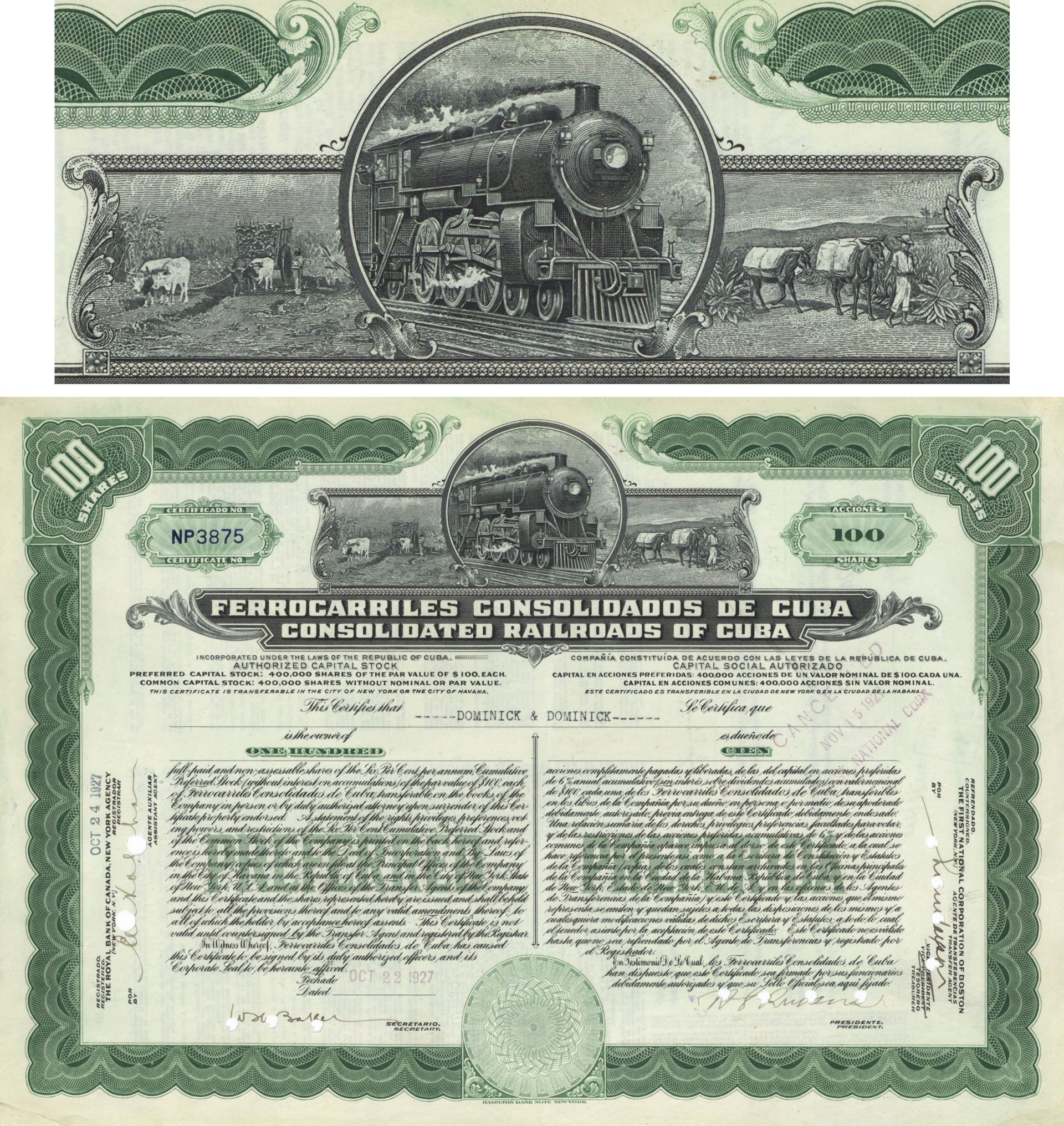
Superb train vignette in circle and 2 plantation scenes in the background. Double text in English and Spanish. A classic!!! Scarce!!! Available in Green or Brown. Please specify color.
Ferrocarriles de Cuba (FCC), also known as Ferrocarriles Nacionales de Cuba (National Railway Company of Cuba), provides comprehensive passenger and freight transportation services throughout Cuba. Sir William Cornelius Van Horne, a Canadian railway builder of American origin, played a pivotal role in the expansion of Cuba’s railway infrastructure during the early 20th century. Notably, Van Horne was an investor in the Cuba Railroad Company, established in 1900.
In 1924, Ferrocarriles Consolidados de Cuba emerged as a result of a dispute between FCC and Ferrocarriles de Cuba. Several other railway companies subsequently emerged and merged during the 1920s, including:
- Ferrocarriles del Norte de Cuba (1916)
- Ferrocarril Espirituano Tunas de Zaza
- Ferrocarril Guantánamo y Occidente
Between 1940 and 1959, Cuba’s railway infrastructure underwent substantial modernization through the procurement of train stock from Budd and Fiat. These trains enabled medium-speed, self-propelled diesel service with four-car configurations along the primary route connecting Havana and Santiago de Cuba. Furthermore, in the aftermath of World War II, an extensive network of diesel intercity buses was established, featuring four or five major operators competing along the east-west corridor between Havana and the eastern provinces. Additionally, several sugar mills transitioned to utilizing diesel-electric locomotives for freight transportation. By 1958, Cuba achieved the highest railway trackage per square mile of any nation.
A stock certificate is issued by businesses, usually companies. A stock is part of the permanent finance of a business. Normally, they are never repaid, and the investor can recover his/her money only by selling to another investor. Most stocks, or also called shares, earn dividends, at the business's discretion, depending on how well it has traded. A stockholder or shareholder is a part-owner of the business that issued the stock certificates.




Ebay ID: labarre_galleries