


 BMW - Bayerische Motoren Werke - 1942 or 1944 dated Stock Certificate (Uncanceled)
Inv# AS1110A
Stock
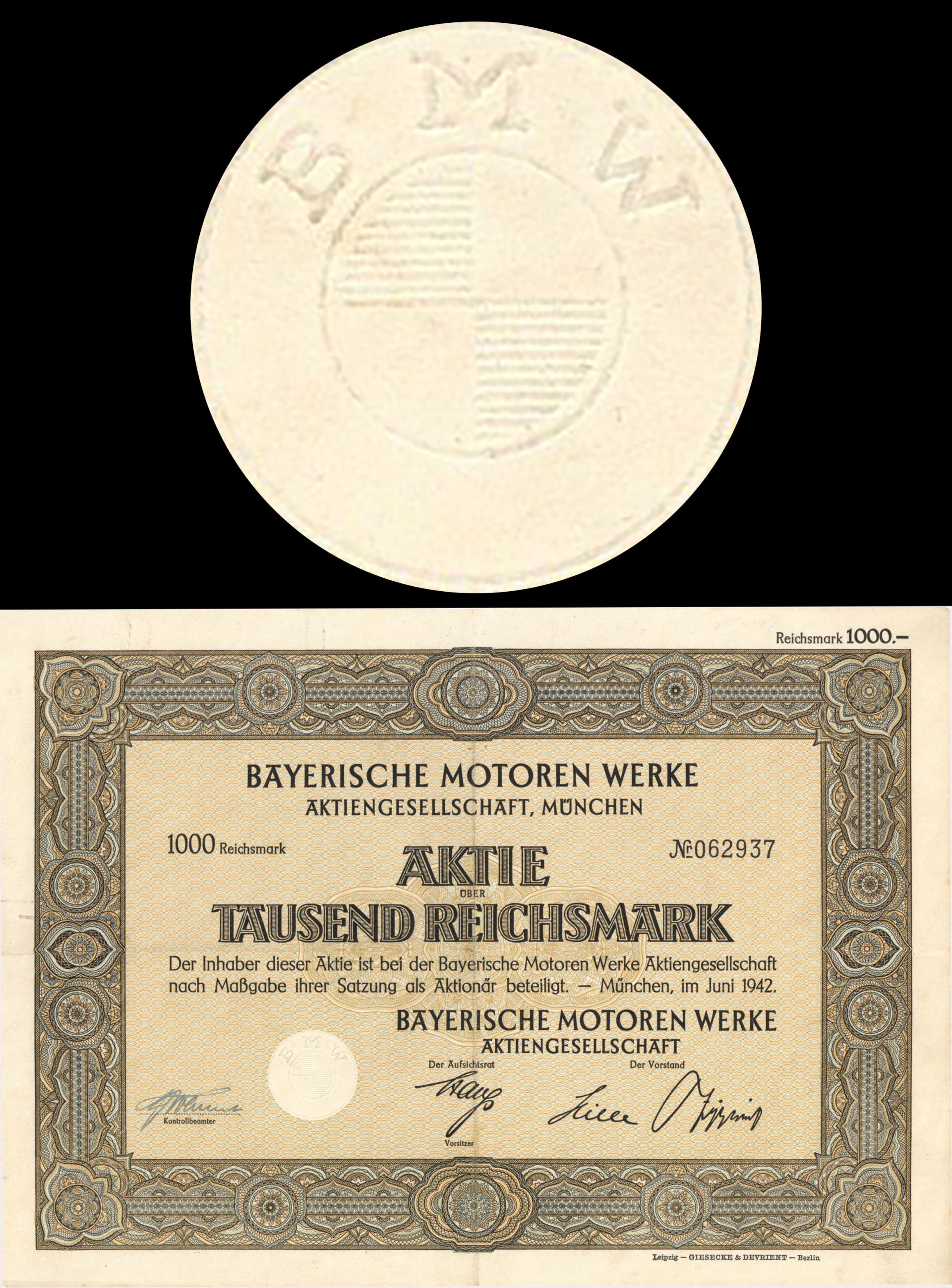
Stock printed by Giesecke & Devrient. Munich, Germany. 1,000 Reichsmark. Available with or without coupons unattached for 1942 or 1944.
Famous BMW Maker! Rare! Bayerische Motoren Werke (BMW), (English: Bavarian Motor Works) is an independent German automobile manufacturer founded in 1916. BMW is a worldwide manufacturer of high-performance automobiles and motorcycles, and is the current parent company of both the MINI and Rolls-Royce car brands. After World War I, BMW (and Germany) were forced to cease aircraft (engine) production by the terms of the Versailles Armistice Treaty. The company consequently shifted to motorcycle production in 1923 once the restrictions of the treaty started to be lifted, followed by automobiles in 1928. The circular blue and white BMW logo or roundel is often alleged to portray the movement of an airplane propeller, an interpretation that BMW adopted for convenience in 1929, which was actually twelve years after the roundel was created. In fact, the emblem evolved from the circular Rapp Motorenwerke company logo, from which the BMW company grew. The Rapp logo was combined with the blue and white colors of the flag of Bavaria to produce the BMW roundel so familiar today. The early success of the outstanding BMW IIIa inline-six aviation engine, from 1917-18 in World War I, with the Luftstreitkräfte in a limited number of Fokker D.VII fighters, as well as a number of prototype "inline-six" fighters from various manufacturers, might have actually influenced the BMW logo's design. BMW's first significant aircraft was the BMW IIIa inline-six liquid-cooled engine of 1918, much preferred for its high-altitude performance. With German rearmament in the 1930s, the company again began producing aircraft engines for the Luftwaffe. Among its successful WWII engine designs were the BMW 132 and BMW 801 air-cooled radial engines, and the pioneering BMW 003 axial-flow turbojet, which powered the tiny, 1944-45-era jet-powered "emergency fighter", the Heinkel He 162 Spatz, and was tested in the A-1b version of the world's first jet fighter, the Messerschmitt Me 262. By 1959 the automotive division of BMW was in financial difficulties and a shareholders meeting was held to decide whether to go into liquidation or find a way of carrying on. It was decided to carry on and to try to cash in on the current economy car boom enjoyed so successfully by some of Germany's ex-aircraft manufacturers such as Messerschmitt and Heinkel. Therefore the rights to manufacture the tiny Italian Iso Isetta were bought using a modified form of BMW's own motorcycle engine. This was moderately successful and helped the company get back on its feet. The dominating shareholder of the BMW Aktiengesellschaft since 1959 is the Quandt family. Stefan Quandt, Johanna Quandt and Susanne Klatten (born Quandt) together own about 46% of the stocks. The rest is in public float. BMW AG bought the British Rover Group (which at the time consisted of the Rover, Land Rover and MG brands as well as the rights to defunct brands including Austin and Morris) in 1994 and owned it for six years. By 2000, Rover was making huge losses and BMW decided to sell the combine. The MG and Rover brands were sold to the Phoenix Consortium to form MG Rover, while Land Rover was taken over by Ford. BMW, meanwhile, retained the rights to build the new MINI, which was launched in 2001.
Established in 1916, Bayerische Motoren Werke AG (BMW) initially embarked on its journey not as an automaker, but rather as a manufacturer of aircraft engines. Emerging from the merger of Rapp Motorenwerke and Bayerische Flugzeugwerke during World War I, the company’s early reputation was established on the foundation of high-performance aviation technology, epitomized by the iconic blue-and-white circular logo commonly associated with rotating propellers. However, the aftermath of the war and the Treaty of Versailles necessitated a significant shift in strategy. Prohibited from producing aero engines, the company redirected its engineering expertise toward motorcycles in 1923 and eventually entered the automobile market in 1928 through the acquisition of the Fahrzeugfabrik Eisenach.
Throughout the mid-20th century, BMW navigated periods of intense challenges and remarkable transformations. After the devastation of World War II nearly precipitated the company’s bankruptcy and a potential takeover by rival Daimler-Benz in the late 1950s, the “New Class” (Neue Klasse) of compact sedans was introduced in the 1960s, effectively salvaging the brand’s reputation. This era defined the modern BMW identity: a manufacturer of sporty, driver-centric luxury vehicles. By the 1970s and 1980s, the introduction of the 3, 5, and 7 Series solidified its global standing. Presently, BMW stands as a leader in the premium automotive sector, harmoniously blending its rich legacy of precision engineering with a forward-oriented focus on electric mobility and sustainable technology.
Established in 1916, Bayerische Motoren Werke AG (BMW) initially embarked on its journey not as an automaker, but rather as a manufacturer of aircraft engines. Emerging from the merger of Rapp Motorenwerke and Bayerische Flugzeugwerke during World War I, the company’s early reputation was established on the foundation of high-performance aviation technology, epitomized by the iconic blue-and-white circular logo commonly associated with rotating propellers. However, the aftermath of the war and the Treaty of Versailles necessitated a significant shift in strategy. Prohibited from producing aero engines, the company redirected its engineering expertise toward motorcycles in 1923 and eventually entered the automobile market in 1928 through the acquisition of the Fahrzeugfabrik Eisenach.
Throughout the mid-20th century, BMW navigated periods of intense challenges and remarkable transformations. After the devastation of World War II nearly precipitated the company’s bankruptcy and a potential takeover by rival Daimler-Benz in the late 1950s, the “New Class” (Neue Klasse) of compact sedans was introduced in the 1960s, effectively salvaging the brand’s reputation. This era defined the modern BMW identity: a manufacturer of sporty, driver-centric luxury vehicles. By the 1970s and 1980s, the introduction of the 3, 5, and 7 Series solidified its global standing. Presently, BMW stands as a leader in the premium automotive sector, harmoniously blending its rich legacy of precision engineering with a forward-oriented focus on electric mobility and sustainable technology.
A stock certificate is issued by businesses, usually companies. A stock is part of the permanent finance of a business. Normally, they are never repaid, and the investor can recover his/her money only by selling to another investor. Most stocks, or also called shares, earn dividends, at the business's discretion, depending on how well it has traded. A stockholder or shareholder is a part-owner of the business that issued the stock certificates.




Ebay ID: labarre_galleries