


Russia Paper Money Note - CU Condition - 1912 dated Russian Paper Money - Peter the Great
Inv# FM1168 Paper Money Cat# P-14b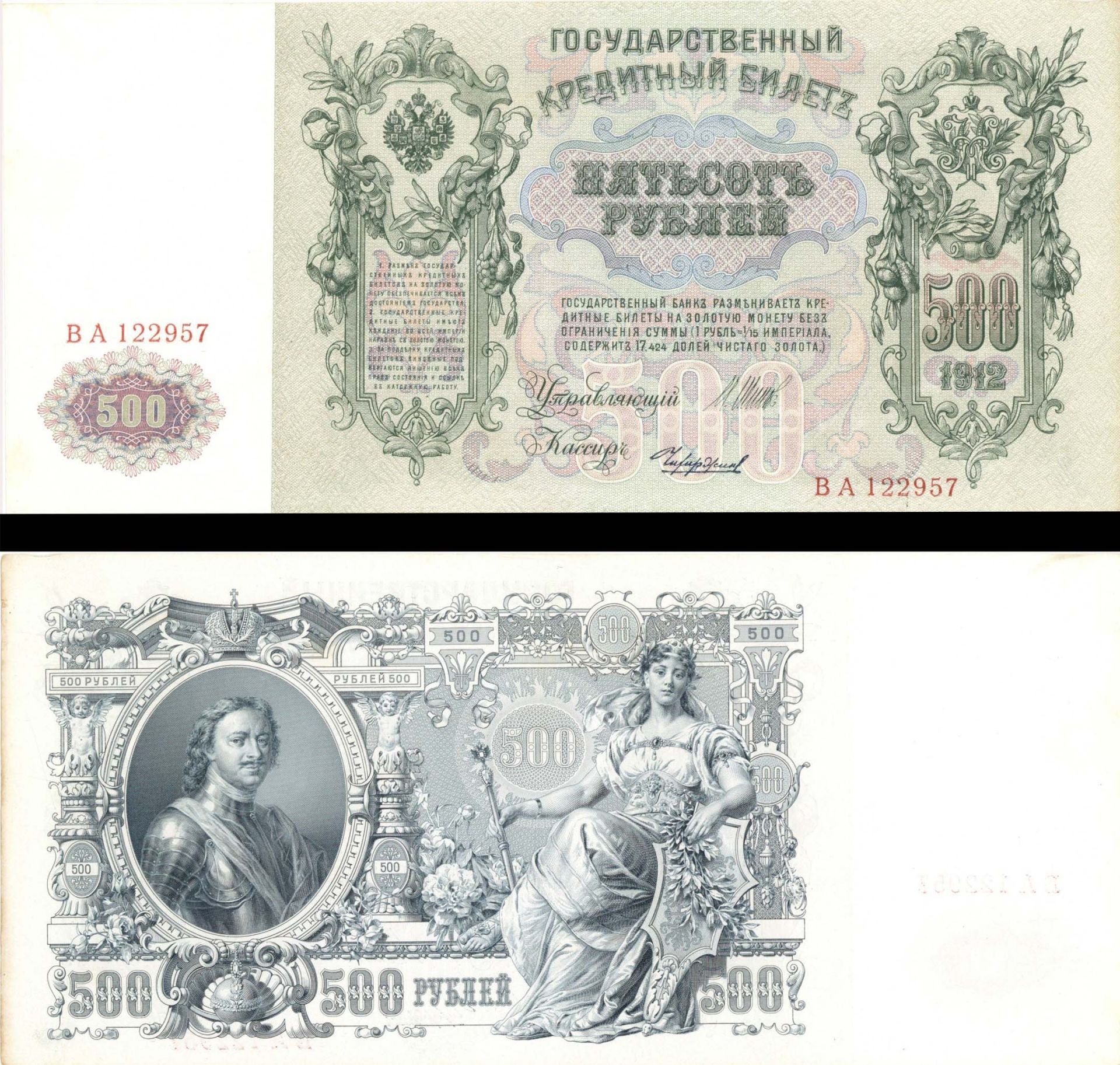
500 Rubles, P-14b. Peter I and Catherine III at back.
Peter the Great, Tsar of Russia from 1682 to 1725, played a pivotal role in transforming Russia into a modern European power. During his reign, he implemented extensive reforms that modernized the military, established the first Russian navy, and reformed the government, education, and economy. A significant event in his reign was his Grand Embassy trip to Western Europe, which inspired him to westernize Russia and establish the new capital, St. Petersburg.
Peter’s reforms were often implemented with great force and were extensive in scope. He modernized the Russian military and, through warfare, significantly expanded the empire’s territory, particularly on the Baltic coast. Additionally, he focused on education, creating schools and simplifying the Russian alphabet to foster a more informed society. By incorporating Western technology and ideas, Peter successfully transformed Russia into a major European power. However, his reforms were sometimes met with resistance from traditionalists who disliked the forced changes to Russian culture and way of life.
Catherine the Great, the longest-reigning empress of Russia, seized power in a 1762 coup against her husband, Peter III. Her 34-year reign is often referred to as a “golden age” for Russia, during which she expanded the empire’s territory, modernized its administration, and championed the arts and Enlightenment ideas through reforms, education, and patronage. While she was a formidable and effective ruler who transformed Russia into a dominant European power, her personal life and relationships have been the subject of numerous rumors and legends.
Catherine’s reign was characterized by territorial expansion, particularly the acquisition of Crimea and parts of Poland. She was also an intellectual force, engaging in correspondence with Enlightenment figures like Voltaire, establishing schools for girls, and founding the Hermitage Museum. Despite her progressive reforms, her policies often favored the nobility, and her relationship with her son, Paul, was strained. This led her to consider alternative heirs before her death in 1796. Catherine’s legacy is a blend of notable achievements and enduring myths, including legends about her personal life and an apocryphal story about her demise.




Ebay ID: labarre_galleries