


Millions Billions Set of 4 - Nicaragua, Turkey, Yugoslavia - 1990-95 dated Collection of 4 Foreign Paper Money Notes
Inv# FM1322 Foreign Paper Money Cat# P-209, P-124, P-137a, P-166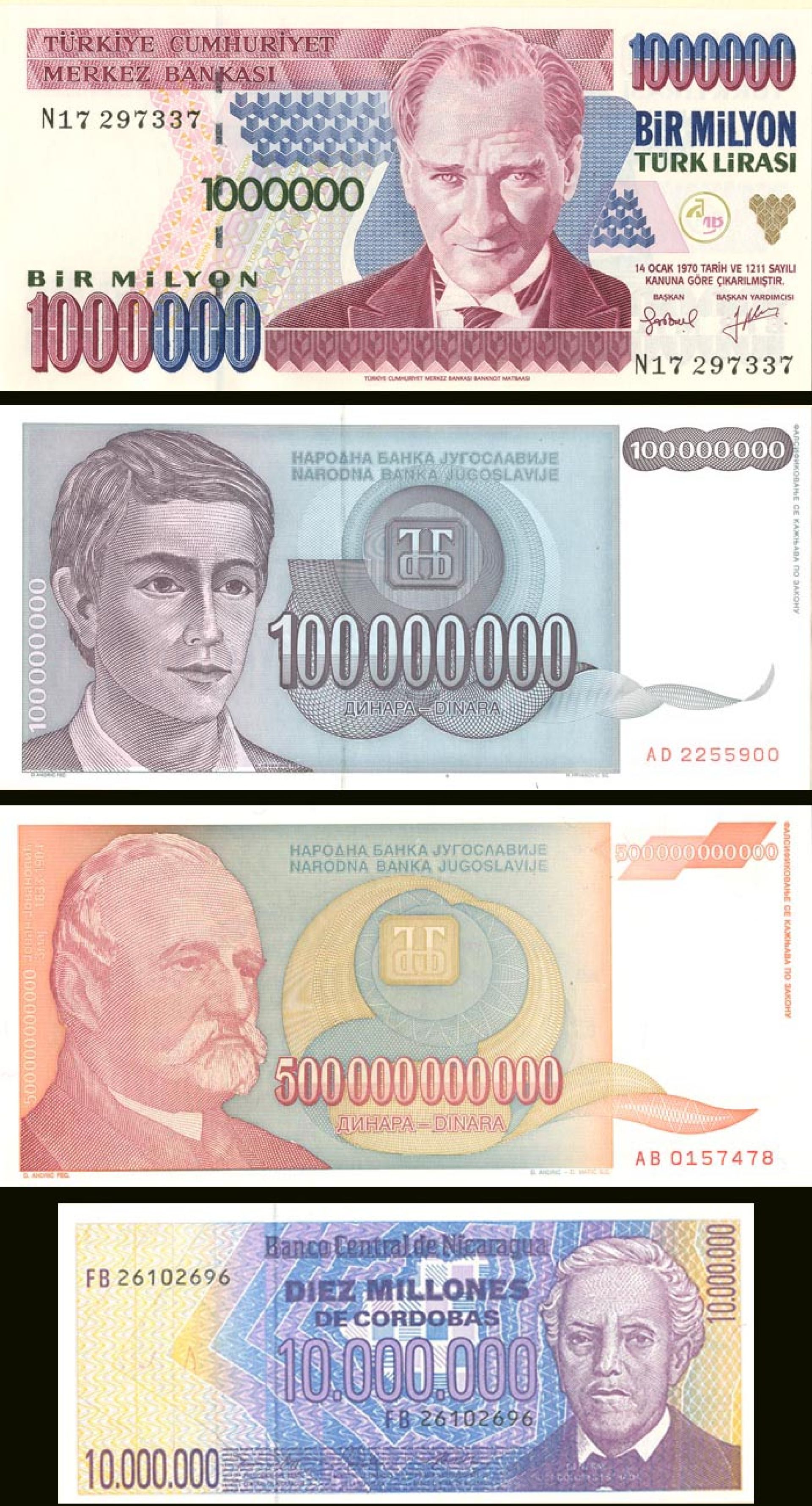
Turkey
Yugoslavia
Turkey, 1 Million Lira, 1992-95, P-209; Yugoslavia, 100 Million Dinara, 1993, P-124; Yugoslavia, 500 Millard (Billion) Dinara, 1993, P-137a, Nicaragua, 10 Million Cordobas, (1990), P-166. CU. Collection of 4.
The old Turkish 1 million lira banknote, issued in 2002, symbolizes the country’s severe hyperinflation in the late 20th and early 21st centuries. During this period, high-denomination notes had minimal purchasing power, necessitating carrying large bundles. To stabilize the economy and restore the lira’s prestige, the Turkish government removed six zeroes from its currency on January 1, 2005, making the old 1 million lira equivalent to just 1 new lira. Today, it’s obsolete and worth only collector’s worth.
In contrast, the 100 Million Dinara banknote issued by Yugoslavia in 1993 represents one of the most severe periods of hyperinflation in modern history. The Federal Republic of Yugoslavia, comprising Serbia and Montenegro, faced economic collapse due to the breakup of the country, regional wars, and international sanctions. The currency’s face value rapidly devalued, prompting the government to issue new banknotes with more zeros to keep pace with soaring prices. The 100 Million Dinara note, featuring a portrait of a young boy and the Serbian Academy of Sciences and Arts, serves as a poignant reminder of this turbulent era and a symbol of a national currency losing all value. Extreme hyperinflation made standard economic activities impossible, forcing citizens to resort to barter or foreign currencies like the German mark to survive.
The 500 billion dinar banknote issued by Yugoslavia in 1993 symbolizes the country’s economic and political collapse during the early 1990s. Printed during extreme hyperinflation, it was part of a series of rapidly escalating denominations to keep pace with soaring prices. The banknote’s release followed Yugoslavia’s breakup, exacerbated by international sanctions and military spending, leading to an uncontrolled growth of the money supply. The obverse depicts poet Jovan Jovanovi? Zmaj, while the reverse features the National Library in Belgrade. However, it quickly lost value, becoming nearly worthless. Citizens were forced to spend their wages immediately or risk losing their purchasing power. For collectors and historians, it serves as a reminder of hyperinflation’s devastation.
The 10 million cordobas banknote issued by Nicaragua in 1990 is another stark symbol of the country’s severe hyperinflation. The Sandinista government’s economic policies, coupled with years of civil conflict and sanctions, led to a rapid devaluation of the currency. By 1990, the cordoba’s value plummeted, forcing the central bank to print notes in increasingly large denominations, with the 10 million note being a prime example. The banknote features military hero José Dolores Estrada on the obverse and an adobe farmhouse at the site of the 1856 National War battle on the reverse. The purple, blue, and yellow banknote illustrates the currency’s near-worthlessness, with new “gold córdobas” introduced to combat the economic chaos and replace the older notes. While no longer in circulation, it remains a historical artifact documenting Nicaragua’s financially challenging era.




Ebay ID: labarre_galleries