


International Railways of Central America - 1912 dated Guatemala Railroad Money Bond - Extremely Rare - First We Have Seen!
Inv# FB6805 Bond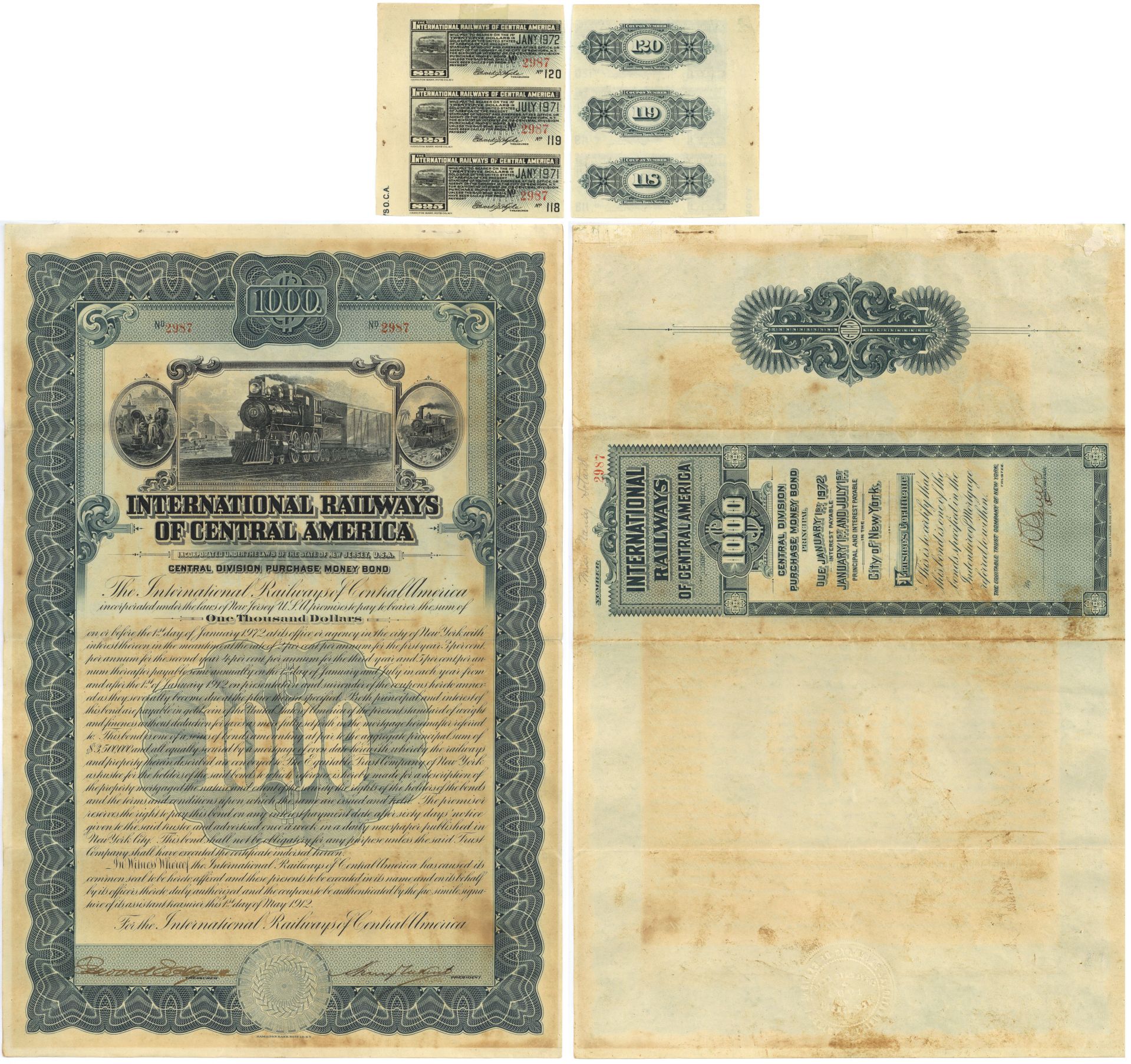
Toning throughout from years of poor framing. Exact piece shown with coupons unattached. Bond printed by Hamilton Bank Note Company. (Related to United Fruit Co.).
The International Railways of Central America (IRCA), established in 1904 by Minor C. Keith, a founder of the United Fruit Company (UFCO), was a U.S.-based company. Initially incorporated in New Jersey, the company gradually consolidated various independent rail lines in Guatemala and El Salvador. By 1912, they had formally merged these lines under the IRCA name. At its peak, the IRCA operated an extensive 800-mile network of 3-foot narrow-gauge tracks, connecting the Atlantic and Pacific coasts from the Mexican border to the Gulf of Fonseca. While the system served general transportation needs for coffee and imported goods, its primary function was transporting bananas from UFCO plantations to major ports like Puerto Barrios. By 1936, the United Fruit Company had officially acquired a controlling interest in the IRCA, solidifying its monopoly over the region’s vital transit infrastructure.
However, the railroad’s dominance began to wane in the mid-20th century due to a confluence of political unrest, legal challenges, and emerging competition. During the Guatemalan Revolution (1944–1954), the IRCA became a target for labor activists and nationalists who criticized its monopolistic practices and inequitable rate structures. An antitrust suit in 1954 eventually forced United Fruit to divest its holdings. Additionally, the construction of parallel, U.S.-financed highways led to a significant decline in rail traffic as trucks became more profitable. Hemorrhaging cash and unable to repay government loans, the IRCA’s Guatemalan division was nationalized on December 27, 1968, becoming the state-owned Ferrocarriles de Guatemala (FEGUA). The El Salvadorian division followed a similar path, merging into a national entity in 1975. Most regular operations ceased by 1996, and while some attempts at private concessions occurred in the late 1990s, much of the historic infrastructure has since been abandoned or dismantled.
A bond is a document of title for a loan. Bonds are issued, not only by businesses, but also by national, state or city governments, or other public bodies, or sometimes by individuals. Bonds are a loan to the company or other body. They are normally repayable within a stated period of time. Bonds earn interest at a fixed rate, which must usually be paid by the undertaking regardless of its financial results. A bondholder is a creditor of the undertaking.




Ebay ID: labarre_galleries