


Chemical New York Corporation - $1,000 Specimen Bond - Banking
Inv# SE1958 Bond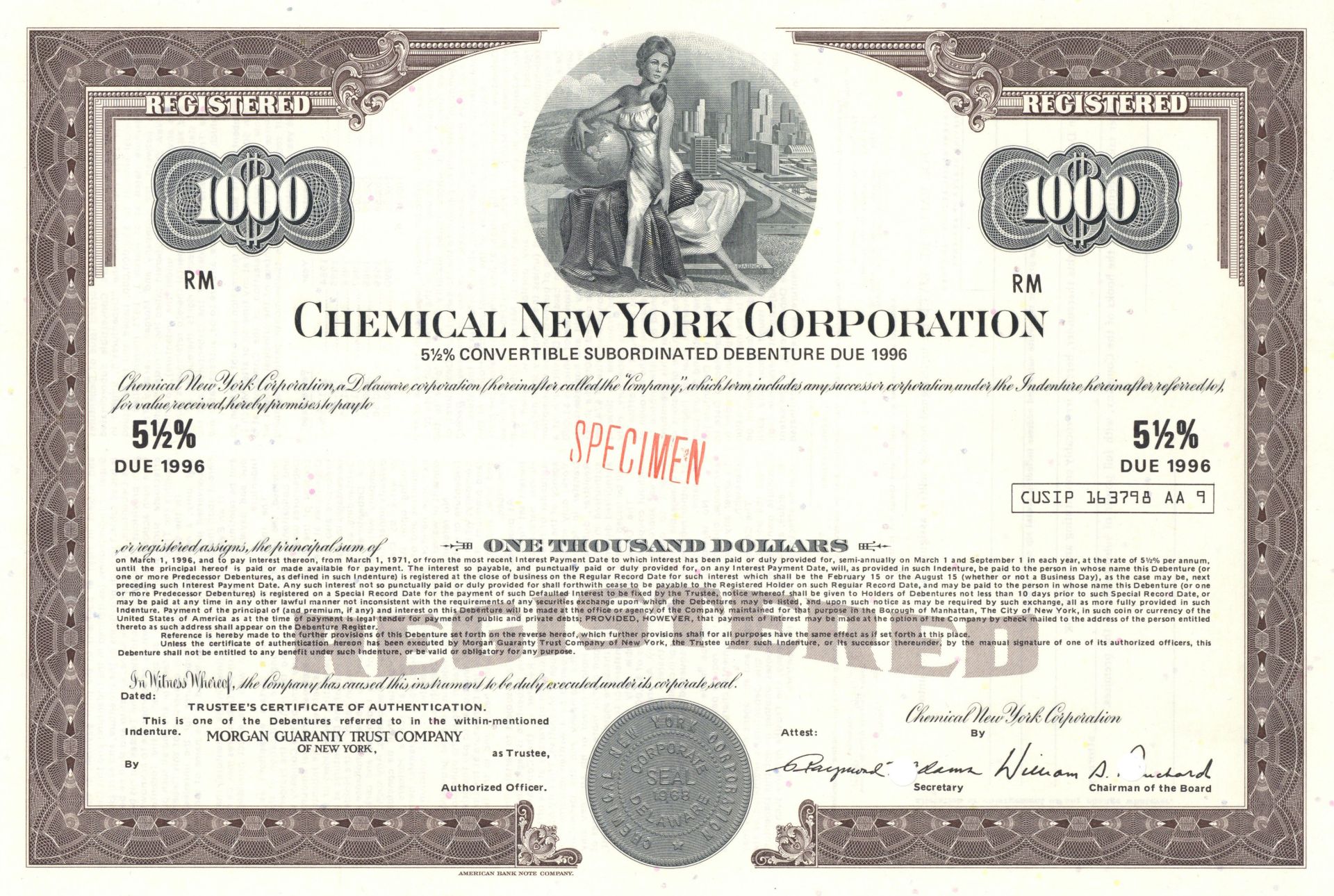
Specimen Brown $1,000 5 1/2% Bond printed by American Bank Note Company.
Chemical New York Corporation played a pivotal role in American banking history, originating from the establishment of the New York Chemical Manufacturing Company in 1823. A year later, the company incorporated a banking division, Chemical Bank. Chemical Bank gained a reputation for sound and conservative practices, earning the moniker “Old Bullion” for its steadfast commitment to redeeming notes in gold during the Panic of 1857, while other institutions suspended specie payments.
After a century of growth and a series of mergers with prominent institutions such as Corn Exchange Bank and New York Trust Company, Chemical Bank underwent a reorganization in 1968 to form the bank holding company, Chemical New York Corporation, facilitating broader expansion. This structure enabled the bank to rapidly grow in size and scope throughout the latter half of the 20th century, culminating in its 1991 merger with Manufacturers Hanover Corporation. This merger elevated Chemical New York Corporation to become the nation’s second-largest bank at the time.
The corporation’s independent existence concluded with a final and decisive merger in 1996. Although Chemical New York Corporation emerged as the acquiring entity and the legal survivor in the $10 billion stock-swap, it adopted the more globally recognized name of the acquired firm, The Chase Manhattan Corporation, to capitalize on its brand recognition. The merged company, still headquartered in the former Chemical offices at 270 Park Avenue, became the largest bank in the United States. The institution continued its expansionary trajectory and eventually merged with J.P. Morgan & Co. in 2000, forming the modern financial powerhouse, JPMorgan Chase & Co., a direct descendant of the original Chemical New York Corporation’s banking operations.
A bond is a document of title for a loan. Bonds are issued, not only by businesses, but also by national, state or city governments, or other public bodies, or sometimes by individuals. Bonds are a loan to the company or other body. They are normally repayable within a stated period of time. Bonds earn interest at a fixed rate, which must usually be paid by the undertaking regardless of its financial results. A bondholder is a creditor of the undertaking.




Ebay ID: labarre_galleries