


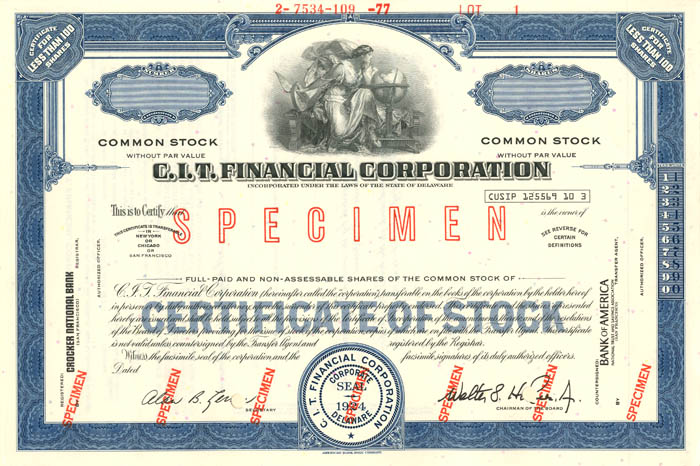
CIT Group began in 1908 when Henry Ittleson founded the Commercial Credit and Investment Company in St. Louis to finance the nation’s growing consumer and industrial economy. After relocating to New York in 1915 and adopting the name Commercial Investment Trust, CIT quickly became an innovator in American finance—introducing the first auto financing agreement in 1916, supporting wartime production, and expanding into consumer appliance and radio financing in the booming 1920s. By the mid-20th century CIT had become a major commercial finance institution, operating internationally, entering the factoring business, and surpassing $100 billion in total financed volume by 1959. Over the following decades, however, the company underwent repeated ownership changes, regulatory shifts, and strategic pivots as it exited auto lending, entered personal finance, and was acquired by RCA in 1980 and later Manufacturers Hanover and Dai-Ichi Kangyo Bank.
CIT returned to public ownership in 1997, expanded aggressively through the $4.2 billion acquisition of Newcourt Credit Group, and reported record earnings in 2000. But the early 2000s proved turbulent: Tyco acquired CIT in 2001 and spun it out again in 2002, and risky subprime and education-lending acquisitions under CEO Jeff Peek ultimately produced billions in losses during the financial crisis. CIT became a bank holding company to access TARP funds but could not stabilize its balance sheet and filed for Chapter 11 bankruptcy on November 1, 2009—one of the largest financial failures in U.S. history. It reemerged weeks later under a prepackaged restructuring, with former Merrill Lynch chief John Thain appointed CEO to oversee its recovery.
In the 2010s, CIT rebuilt itself through targeted acquisitions—most notably OneWest Bank in 2015—and a sweeping simplification effort under CEO Ellen Alemany, who sold off non-core divisions including aircraft leasing, reverse mortgages, and European rail assets. The company’s final major transaction as an independent institution was the acquisition of Mutual of Omaha Bank in 2020. Later that year, CIT agreed to merge with First Citizens BancShares, bringing an end to more than a century of independent operations. Its history reflects the broader cycles of American finance: early innovation, mid-century expansion, late-century consolidation, a dramatic collapse, and eventual absorption into a larger modern banking institution.




Ebay ID: labarre_galleries