

North American Phonograph Co. signed by Jesse H. Lippincott - Fantastic Graphics - 1891 dated Stock Certificate
Inv# PH1005 Stock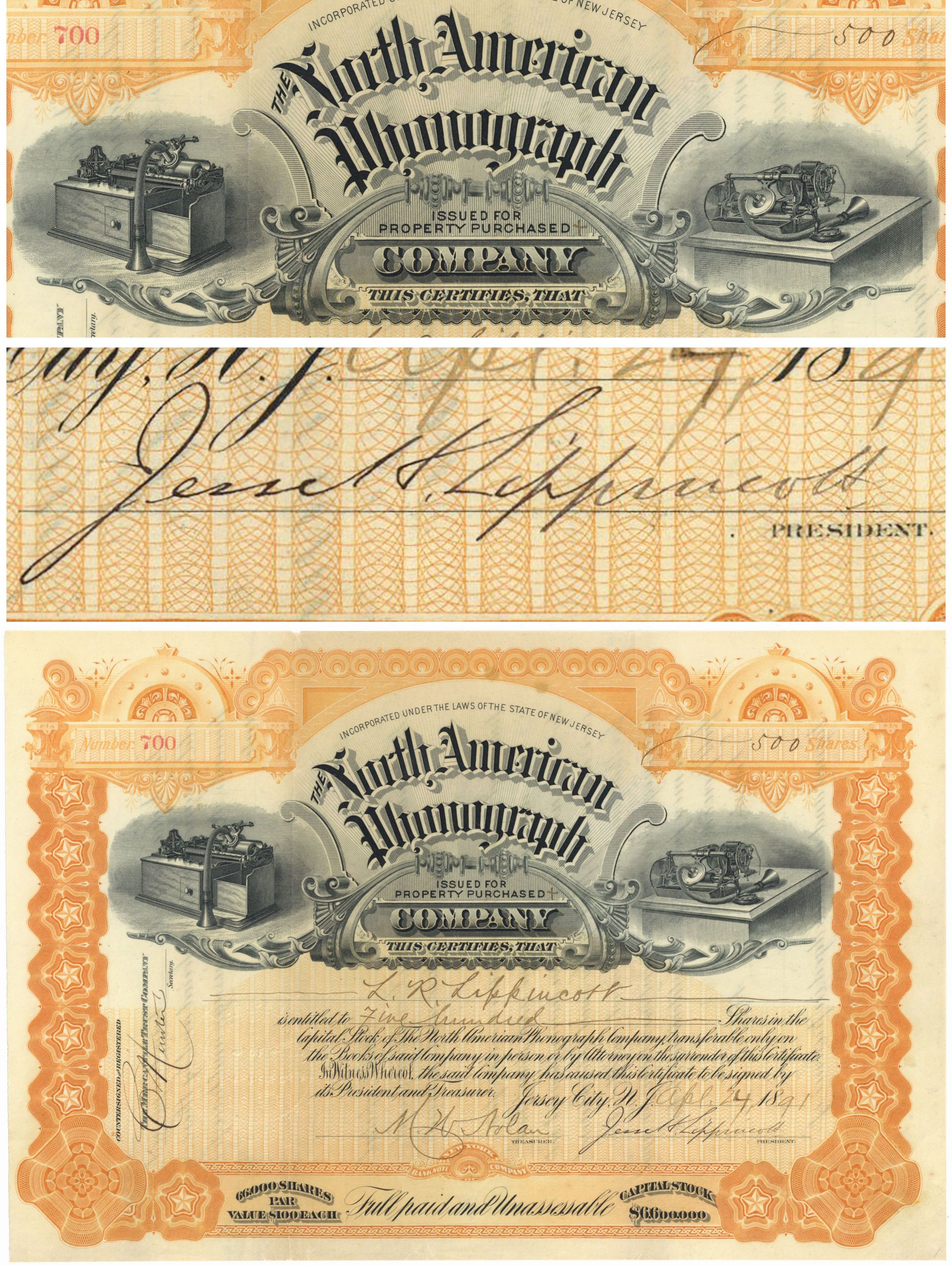
New York
Stock printed by New York Banknote Company. Attractive stock in bold orange and black colors! Issued to Lily R. Lippincott (wife of Jesse) and signed as President by Jesse H. Lippincott.
The North American Phonograph Company, an early attempt to commercialize sound recording in the late 1880s and early 1890s, faced legal, technical, and financial challenges despite its goals. However, it laid the foundation for the modern recording industry in the mid-1890s.
Thomas Edison demonstrated sound recording and reproduction in 1877 with the tinfoil Phonograph, but its low fidelity and single-use nature limited its practical utility. He sold the rights to the Phonograph to the Edison Speaking Phonograph Company in 1878 and focused on electric light.
Between 1880 and 1885, Alexander Graham Bell and his associates at the Volta Laboratory experimented with improved sound recording processes, eventually settling on cutting wax cylinders. On January 6, 1886, they formed the Volta Graphophone company and patented their process. Later that year, Edison resumed research on the Phonograph. In 1887, the Volta associates established the American Graphophone Company, and Edison organized the Edison Phonograph Company to protect his research.
In 1888, Jesse Lippincott, a Pennsylvania businessman, licensed the Graphophone and phonograph patents. He chartered the North American Phonograph Company in Jersey City, New Jersey, and founded the Edison Phonograph Works for phonograph manufacture. American Graphophone opened a factory in Bridgeport, Connecticut. North American bought Phonographs and Graphophones and leased them to regional sub-companies, who rented them to local businesses for dictation.
However, the Edison Speaking Phonograph Company, holding Edison’s tinfoil Phonograph patents, threatened legal action against North American, claiming rights to Edison’s improvements until 1912. Lippincott settled with the company, spending hundreds of thousands of dollars intended for capital investment.
Between 1889 and 1891, thirty-four regional sub-companies were formed and licensed exclusive territorial rights from North American. To fund manufacture, Lippincott sold stock in the parent company, but investors were wary due to the Edison Speaking Phonograph Company’s protests.
In 1889, North America’s limited capital hindered the manufacture of Phonographs and Graphophones. Local companies found leased machines unreliable and difficult to use, and some found it more profitable to exhibit entertainment recordings than rent machines.
In February 1890, the Automatic Phonograph Exhibition Company formed, patenting a device that allowed companies to exhibit Phonographs with a coin-slot attachment, similar to a jukebox. Companies realized entertainment was more profitable than dictation, and the automatic machine was the most effective way to achieve this. North America, recognizing this, signed an agreement with Automatic in April, allowing local companies to do business with them.
As the automatic exhibition model gained traction, American Graphophone’s dictation-optimized format (known today as ‘Bell-Tainter cylinders’) fell behind. Lippincott’s initial agreement with American Graphophone committed North American to buy 5,000 graphophones annually and pay a royalty of $20 on each. Unable to sell these unpopular machines, North America’s board offered to pay American Graphophone $100,000 annually to disclaim their previous order.
By 1890, North American owed the Edison Phonograph Works and missed Automatic’s coin-slot income. In December, North American instructed local companies to sell Phonographs and Graphophones. The Automatic Phonograph Exhibition Company filed an injunction, citing their April agreement allowing unrestricted sale. The temporary injunction was granted in December 1890 and made permanent in January 1891.
In May 1891, North American was forced into assignment due to unpaid debts. In July, Automatic agreed to sell 1,000 machines to pay off debts, but they couldn’t be sold for automatic exhibition. Lippincott left the company in late 1890 due to illness, and Samuel Insull became president. Edison joined the board of directors to help repair the company’s finances.
In 1892, struggling to pay debts, North American took financial measures. In June, it issued bonds to ease liquidity. In July, Edison became president. Automatic agreed to sell Phonographs freely, and North American offered a 10% royalty to local companies for territorial rights. Most accepted.
Under Edison, North American continued selling Phonographs and offered installment plans. Edison planned to continue this for another year before consolidating his interests in manufacture and sales.
In November 1893, the Edison United Phonograph Company, holding exclusive rights to market Phonographs in England, sued North American for violating their rights by allowing local companies to sell them there.
In January 1894, Edison stepped down as president of North American, and its founder Jesse Lippincott died in April. This allowed American Graphophone, which had licensed North American’s manufacturing rights, to sell Graphophones directly to the public. However, in June, Edison demanded payment on North American’s outstanding debts, and in August, North American, unable to pay, was forced into receivership. In October, American Graphophone stated that Edison’s Phonographs, which incorporated American’s patents, infringed on their rights and could not be sold.
Throughout 1895, Edison attempted to buy North American’s assets to recover his patents and resume manufacture and sale, but other creditors blocked the purchase, fearing Edison would not pay their debts. In the same year, American Graphophone acquired Columbia Phonograph Company, a strong regional sub-company of North American, and debuted the spring-motor powered ‘Type N’ Graphophone, resolving a fundamental problem of previous Graphophones.
In 1896, the court in charge of the North American receivership allowed Edison to buy North American’s assets, including its liabilities. Edison formed the National Phonograph Company in January 1896, transferring North American’s patents and supplies. They fought American Graphophone and Columbia Phonograph over patents throughout 1896. When the judge died in December 1896, they agreed to cross-license patents and started the phonograph business in earnest in 1897.
Edison and Columbia competed in spring-powered home phonographs and wax cylinder records from 1897. Edison continued with cylinder records, debuting the mass-producible Gold-Moulded cylinder in 1902. Columbia transitioned to the disc format from 1901 to 1908 and competed with Victor Talking Machine Company, which inherited the disc business from Berliner’s Gramophone.
The North American Phonograph Company dissolved in June 1898 after Edison settled with Edison United. Local phonograph companies sued Edison, threatening a class-action suit in 1900 before their contracts expired. Minor battles continued until April 1909, when National Phonograph acquired the New York Phonograph Company. Columbia Phonograph Company, General (part of North American) dissolved in June 1913.
A stock certificate is issued by businesses, usually companies. A stock is part of the permanent finance of a business. Normally, they are never repaid, and the investor can recover his/her money only by selling to another investor. Most stocks, or also called shares, earn dividends, at the business's discretion, depending on how well it has traded. A stockholder or shareholder is a part-owner of the business that issued the stock certificates.




Ebay ID: labarre_galleries