


RJR Holdings Group, Inc. - Famous Tobacco Company Bond dated 1989 - Merged with Nabisco Brands
Inv# TC1012 Bond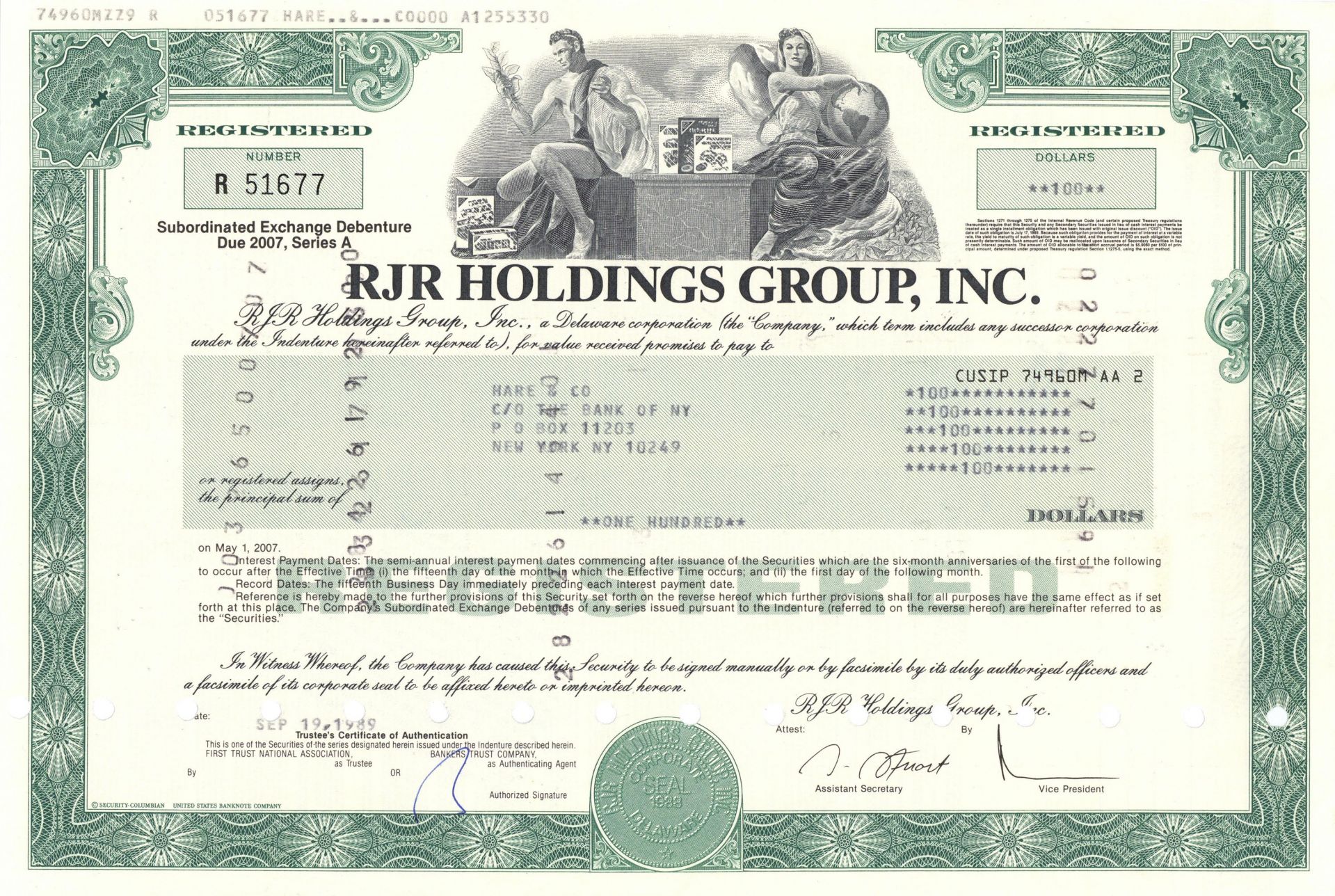
Various Denominations. Security-Columbian US Banknote Co.
The history of RJR Nabisco Holdings Group, commonly known through its primary operating entities, is a defining chapter in 20th-century American capitalism. It began with a massive industrial merger and a record-breaking financial takeover. The company’s origins can be traced back to two prominent figures: R.J. Reynolds, who founded his namesake tobacco company in 1875, and the National Biscuit Company (Nabisco), established in 1898. In 1985, these two titans merged to form RJR Nabisco, a formidable conglomerate that controlled some of the world’s most recognizable brands, including Camel cigarettes and Oreo cookies. The merger was strategically aimed at providing the tobacco business with a “shield” of stable consumer food products to counter increasing litigation and health concerns associated with smoking.
However, RJR Nabisco is perhaps most renowned for the 1988 leveraged buyout (LBO) orchestrated by the private equity firm Kohlberg Kravis Roberts & Co. (KKR). Initiated by the company’s own CEO, F. Ross Johnson, the bidding war was fierce and public. Ultimately, KKR emerged victorious, seizing control of the company for a staggering $25 billion—a figure that held the record for the largest LBO in history for nearly two decades. This era was immortalized in the book and film Barbarians at the Gate, which epitomized the “greed is good” corporate culture of the 1980s.
Over the subsequent decade, the immense debt incurred during the buyout forced the company to divest several divisions. Eventually, the tobacco and food divisions were completely sold off. The domestic tobacco business was acquired by Reynolds American, while the food business was taken over by Philip Morris (now Altria/Kraft Foods).
A bond is a document of title for a loan. Bonds are issued, not only by businesses, but also by national, state or city governments, or other public bodies, or sometimes by individuals. Bonds are a loan to the company or other body. They are normally repayable within a stated period of time. Bonds earn interest at a fixed rate, which must usually be paid by the undertaking regardless of its financial results. A bondholder is a creditor of the undertaking.




Ebay ID: labarre_galleries