


Chinese £100 British Pounds Reorganization Gold Loan Blue Bond of 1913 with PASS-CO authentication - HSBC - Uncanceled Gold Bond of China
Inv# FB5055 Bond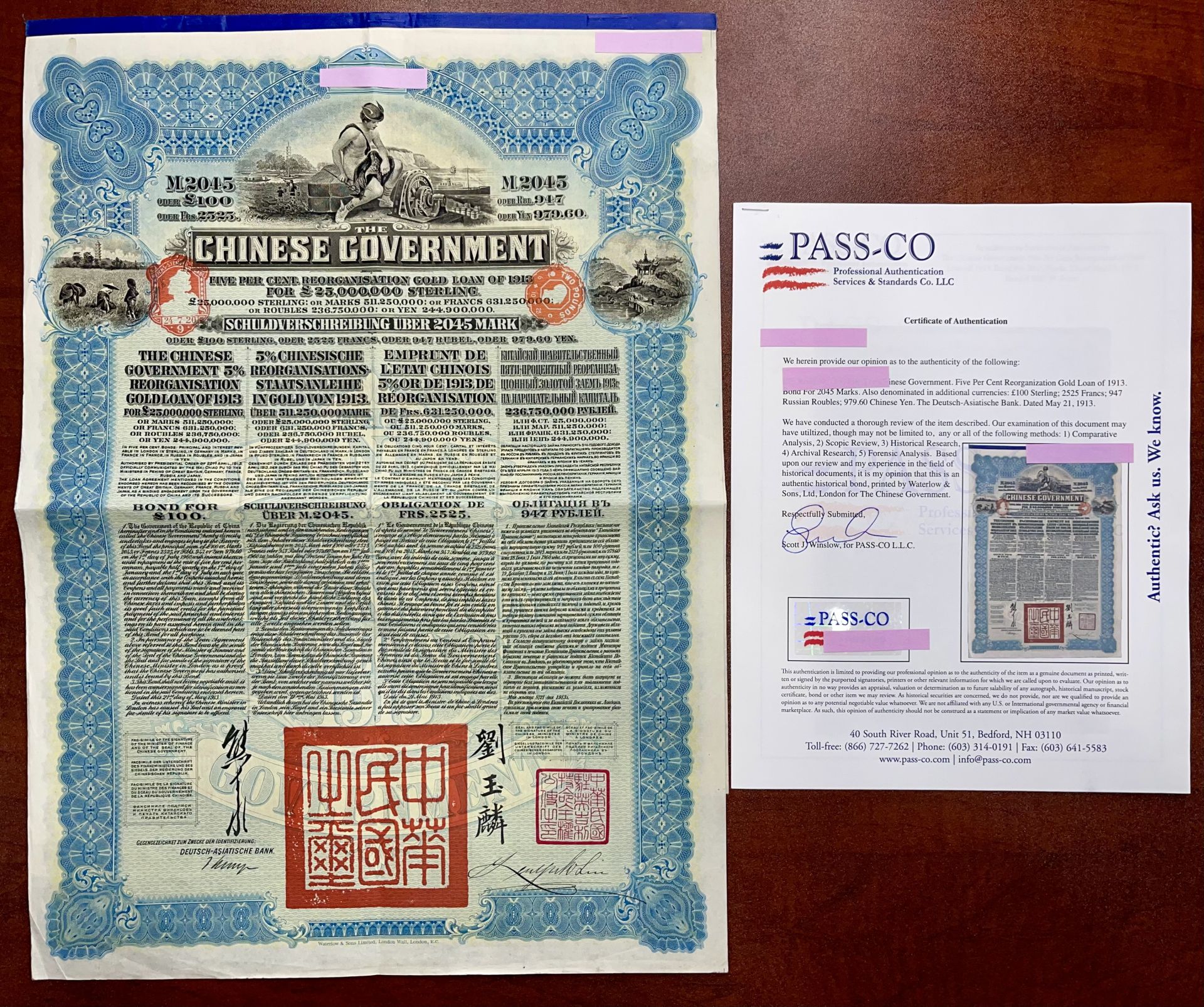
China, 1913, Blue-Red. £100 5% Reorganization Gold Loan Bond, German Bank Issued. Uncanceled. 42-43 Coupons. Many coupons. Article relating to this Chinese item: https://www.bloomberg.com/news/articles/2019-08-29/trump-s-new-trade-war-weapon-might-just-be-antique-china-debt
In 1913, the Reorganization Gold Loan was authorized by Presidential Order on April 22nd. This loan, totaling £25,000,000, was officially communicated to the Ministers in Peking of Great Britain, Germany, France, Russia, and Japan. Initially, the newly appointed President of the Republic of China, Yuan Shih Kai, sought substantial loans from Britain, France, Germany, and the United States of America to aid the fledgling government. Later, Japan and Russia joined the group, but the United States withdrew, leaving five countries to provide financial assistance to the Chinese Government.
The principal financial institutions involved in the loan arrangements were the Hongkong & Shanghai Banking Corporation, Deutsch-Asiatiche Bank, Banque de I’Indo-Chine, and Russian Asiatic Bank. Yokohama Specie Bank participated on behalf of Japan but did not issue separate bonds. The bearer bonds issued by the other four banks were converted into Japanese Yen. Each bank received a 6% commission, and the details of the bonds issued are provided in the data tables below:
- Hongkong & Shanghai Banking Corporation: £7,416,680
- Deutsch-Asiatiche Bank: £6,000,000
- Banque de I’Indo-Chine: £7,416,660
- Russian Asiatic Bank: £2,777,780
- Russian Asiatic Bank (Belgium): £1,388,880
The purpose of the loan was to assist the new government of the Republic of China in meeting financial obligations inherited from the previous government institutions and administrative costs. The loan was secured by the entire revenues of the Salt Administration of China. While this was a questionable security for such a substantial loan, as the entire Salt Gabelle (Salt Tax) had already been allocated for other purposes, with any surplus pledged as security against the Crisp Loan of 1912, there was an additional provision. Foreigners were to assist in reorganizing the collection of Salt Tax revenues, and if the loan defaulted, the Salt Tax revenues were to be administered by the Maritime Customs Administration, which was primarily controlled by foreigners. Coupons were payable on January 1st and July 1st each year. The loan has been in default since 1939. As an interesting footnote, Mr. M.E. Weatherall, a senior official of the Chinese Maritime Customs Service in 1921, was quoted in the publication “Wayfoong” as making the following observation: “I believe that I am correct in stating that the majority, if not all, of the reorganization loan of 1913 was accounted for by statements and vouchers, but that in reality, very little of it was ever applied to the purposes for which it was lent. It mysteriously disappeared, and no one knows where it has gone.”
Song Jiaoren was assassinated in March 1913. Some people believe that Yuan Shikai was responsible, and although it has never been proven, he had already arranged the assassination of several pro-revolutionist generals. Animosity towards Yuan grew. In April he secured a Reorganization Loan of 25 million pounds sterling from Great Britain, France, Russia, Germany and Japan, without consulting the parliament first. The loan was used to finance Yuan's Beiyang Army.
On 20 May, Yuan concluded a deal with Russia that granted Russia special privileges in Outer Mongolia and restricted Chinese right to station troops there. Kuomintang members of the Parliament accused Yuan of abusing his rights and called for his removal. On the other hand, the Progressive Party, which was composed of constitutional monarchists and supported Yuan, accused the Kuomintang of fomenting an insurrection. Yuan then decided to use military action against the Kuomintang.
In July 1913 seven southern provinces rebelled against Yuan, beginning the Second Revolution. There were several underlying reasons for the Second Revolution besides Yuan's abuse of power. First, most Revolutionary Armies from different provinces were disbanded after the establishment of the Republic of China, and many officers and soldiers felt that they were not adequately compensated for overthrowing the Qing Dynasty. These factors gave rise to much discontent against the new government among the military. Secondly, many revolutionaries felt that Yuan Shikai and Li Yuanhong were undeserving of the posts of presidency and vice presidency, because they acquired the posts through political maneuvering rather than participation in the revolutionary movement. Lastly, Yuan's use of violence (such as Song's assassination) dashed the Kuomintang's hope of achieving reforms and political goals through electoral means.
However, the Second Revolution did not fare well for the Kuomintang. The leading Kuomintang military force of Jiangxi was defeated by Yuan's forces on 1 August and Nanchang was taken. On 1 September, Nanjing was taken. When the rebellion was suppressed, Sun and other instigators fled to Japan. In October 1913 an intimidated parliament formally elected Yuan Shikai President of the Republic of China, and the major powers extended recognition to his government. Duan Qirui and other trusted Beiyang generals were given prominent positions in the cabinet. To achieve international recognition, Yuan Shikai had to agree to autonomy for Outer Mongolia and Tibet. China was still to be suzerain, but it would have to allow Russia a free hand in Outer Mongolia and Tanna Tuva and Britain continuation of its influence in Tibet.
A bond is a document of title for a loan. Bonds are issued, not only by businesses, but also by national, state or city governments, or other public bodies, or sometimes by individuals. Bonds are a loan to the company or other body. They are normally repayable within a stated period of time. Bonds earn interest at a fixed rate, which must usually be paid by the undertaking regardless of its financial results. A bondholder is a creditor of the undertaking.




Ebay ID: labarre_galleries