


Bank of Upper Canada Exchange Draft dated 1851 - Canadian Third Exchange - Mounted on Thin Card
Inv# FC1005 Check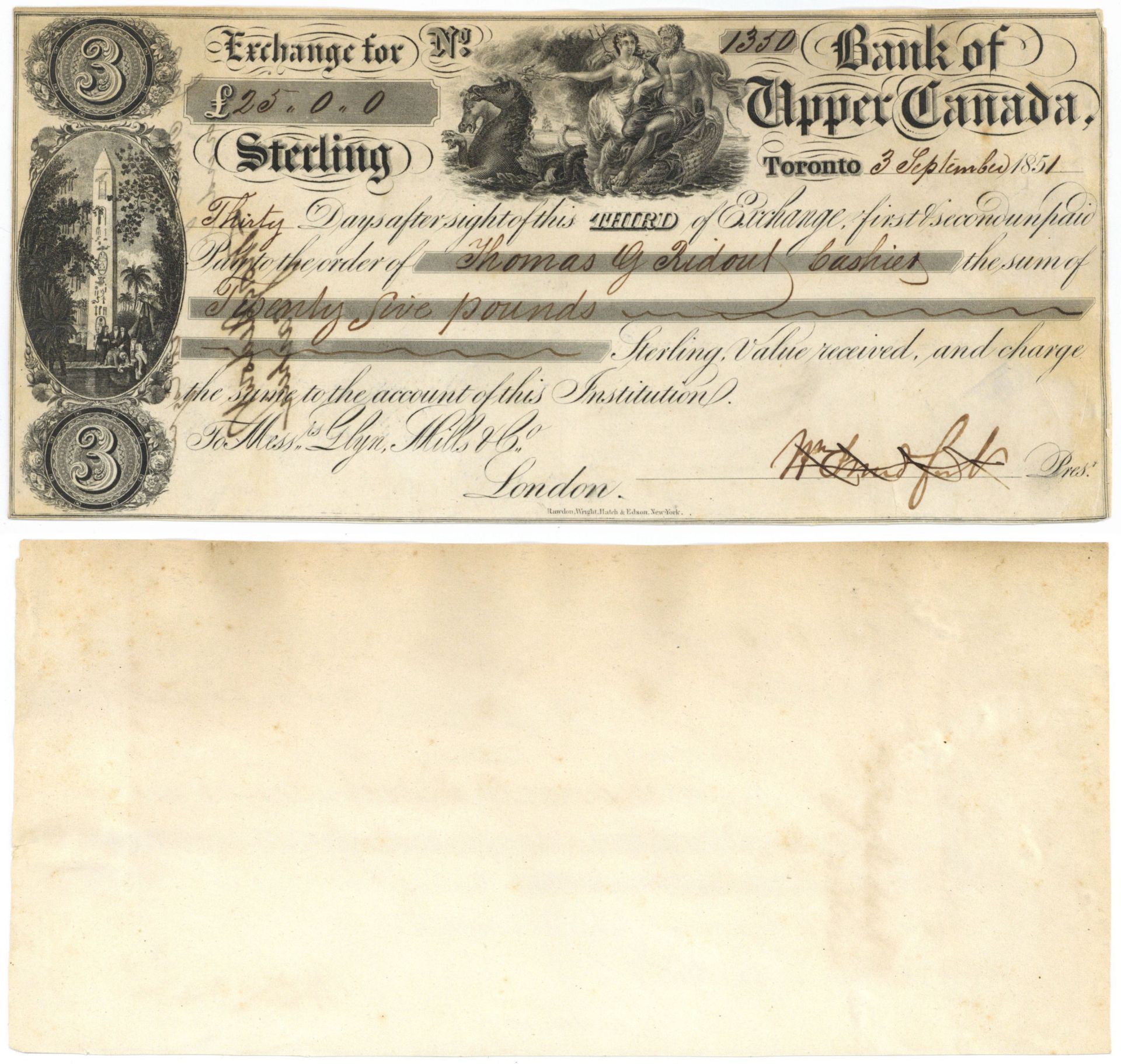
England
25 Pounds Sterling Exchange Draft mounted to thin card. Rare!
The Bank of Upper Canada, established in 1821, was granted a charter by the legislature of Upper Canada in 1819 to a group of Kingston merchants. However, the more influential Executive Councillors appropriated the charter to the Lt. Governor, the Rev. John Strachan, and William Allan, who then moved the bank to Toronto. The bank was closely associated with the Family Compact, a group that came to be known for its underhanded practices, and formed a significant part of their wealth. This association led Reformers, including Mackenzie, to view the Bank of Upper Canada as a prop of the government. Complaints about the bank were a recurring issue in Reform agitation during the 1830s due to its monopoly and aggressive legal actions against debtors.
The first Bank of Upper Canada was located on the southeast corner of King and Frederick streets in York, Upper Canada (later Toronto, Canada West). However, York was deemed too small for a bank, and its promoters faced challenges in raising even the minimum 10% of the £200,000 authorized capital required for its start-up. Despite these obstacles, the bank succeeded because its promoters possessed political influence that allowed them to reduce the minimum capital requirement by half. Consequently, the provincial government subscribed for 2000 of its 8000 shares, and the lieutenant-governor appointed four of the bank’s fifteen directors, establishing a close bond between the nominally private company and the state. Despite this tight bond, the reform-leaning Receiver General, John Henry Dunn, refused to use the bank for government business.




Ebay ID: labarre_galleries