


$5 Confederate Note - T-60 - CR-450-64 - Confederate States of America
Inv# CF1152 Paper Money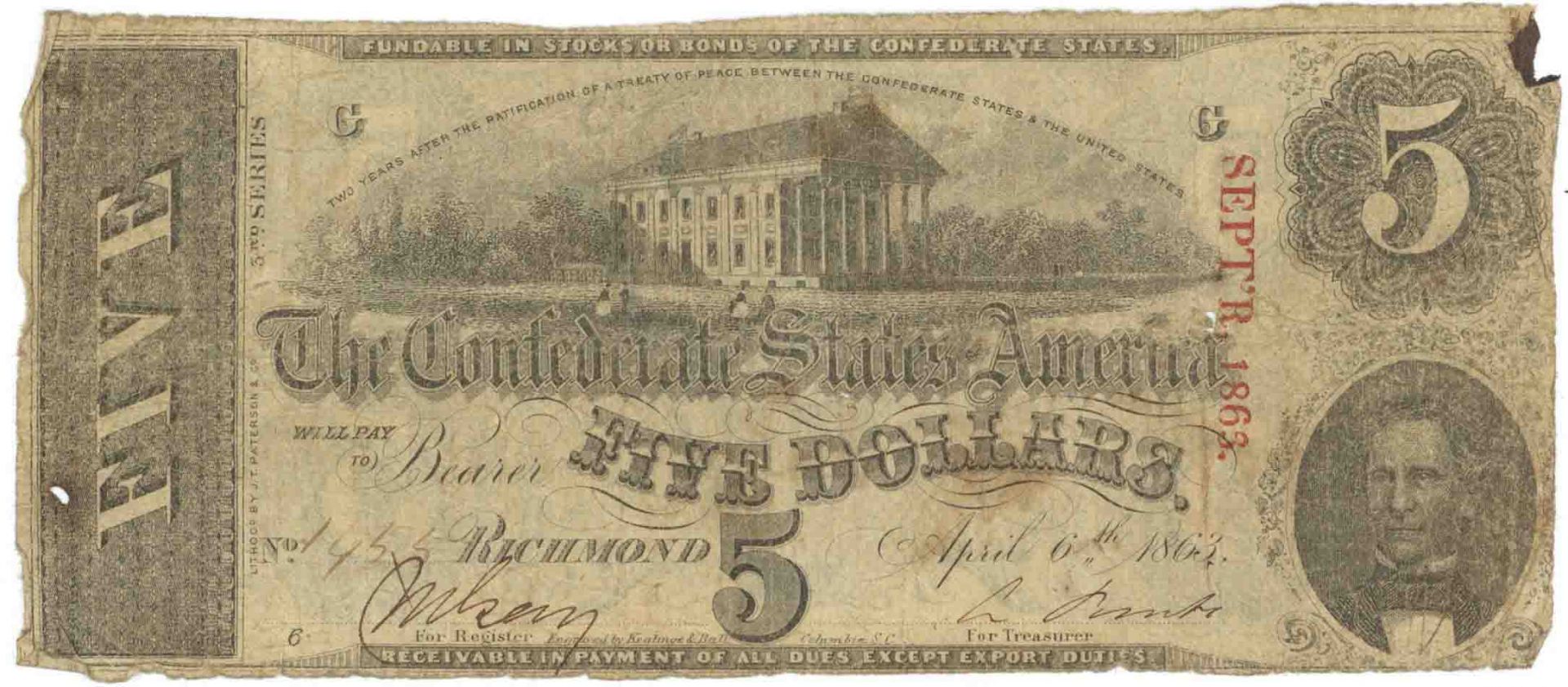
$5 CSA note, T-60, CR-450-64. Poor to Good Condition.
Initially, Confederate currency was widely accepted throughout the South as a medium of exchange with significant purchasing power. However, as the war progressed, confidence in the Confederate States’ ultimate success waned. Consequently, the amount of paper money increased, and its redemption dates were extended further into the future. Notably, most Confederate currency bore the phrase “SIX MONTHS AFTER THE RATIFICATION OF A TREATY OF PEACE BETWEEN THE CONFEDERATE STATES AND THE UNITED STATES” across the top of the bill, followed by “CONFEDERATE STATES OF AMERICA WILL PAY [amount of bill] TO BEARER” (or “…WILL PAY TO BEARER [amount of bill]” or “…WILL PAY TO BEARER ON DEMAND [amount of bill]”).
As the war progressed, the currency underwent the depreciation and soaring prices characteristic of inflation. For instance, when news of the Confederate defeat at Gettysburg reached the public, the Confederate currency depreciated by 20%. In response, Confederate President Jefferson Davis requested that private citizens collectively restore the value of the Confederate dollar by agreeing to sell and buy items only at reduced prices. In October 1863, Confederate States Senator Louis Wigfall of Texas revealed that a Confederate soldier received $11 per month in pay, which was equivalent to the value of $1 at the beginning of the war. In September 1864, the value of a Confederate dollar had fallen to the same level as three cents of United States currency. To preserve their wealth, people resorted to buying gold to such an extent that in Richmond, it became challenging to find someone willing to sell their gold. By Christmas 1864, the Confederate dollar’s value had plummeted to such an extent that a turkey was sold for $155, while a ham was priced at $300. By the war’s conclusion, a cake of soap could fetch as much as $50, and an ordinary suit of clothes was priced at $2,700.




Ebay ID: labarre_galleries