

Minnesota Mining and Manufacturing Co. signed by John Dwan and Henry S. Bryan - 3M Company - 1902-1905 dated Autographed Stock Certificate
Inv# AG1027 Autograph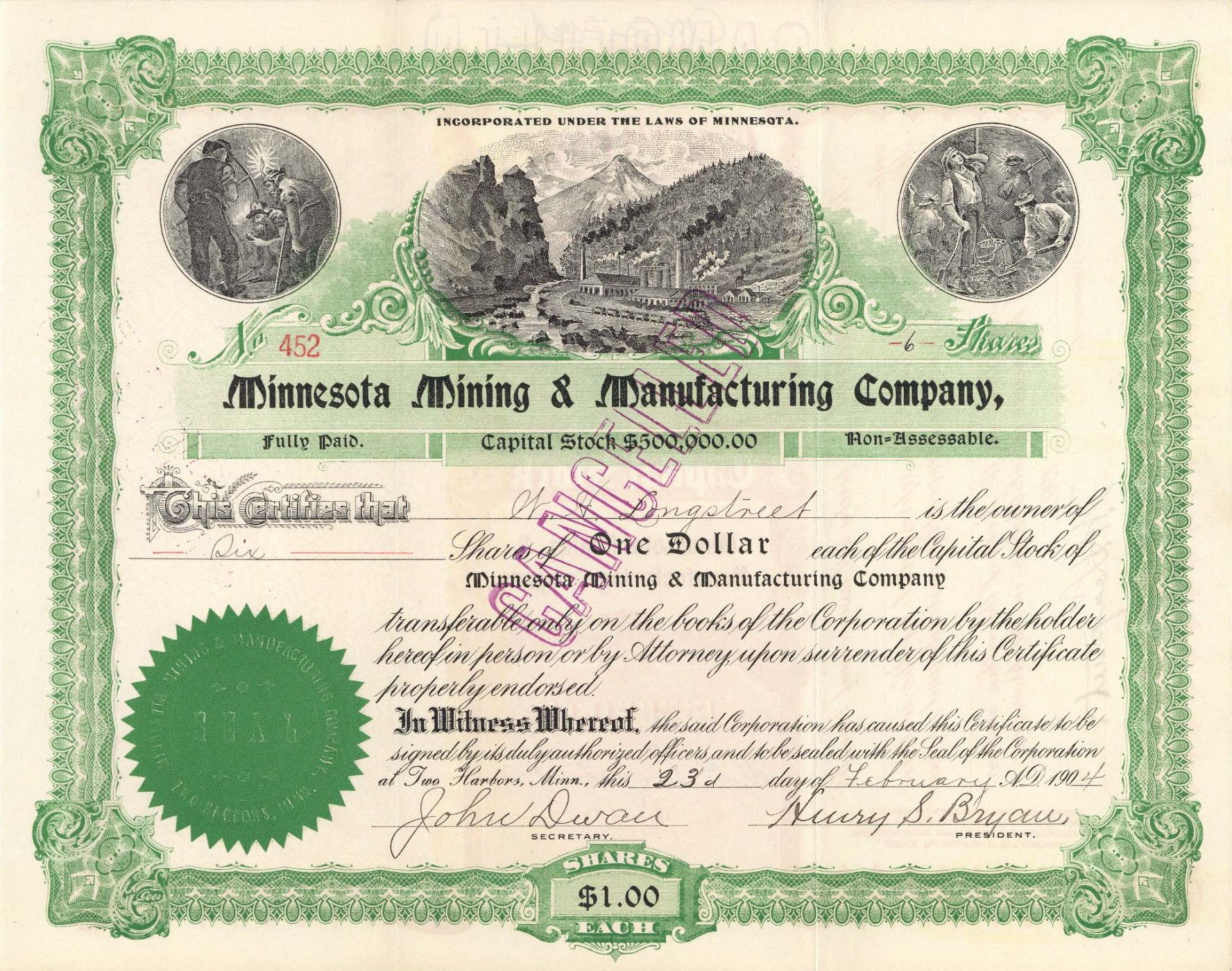
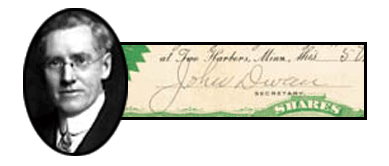
John Dwan, one of the five original founders of the Minnesota Mining and Manufacturing Company, now globally recognized as 3M, played a pivotal role in the company’s inception. A prominent attorney in Two Harbors, Minnesota, Dwan provided the legal foundation for the enterprise by drafting its incorporation papers in 1902 within his own law office. Alongside his four partners, Dwan initially aimed to capitalize on the industrial demand for abrasives by mining corundum, a mineral essential for grinding wheels.
Dwan’s contributions extended beyond legal matters. He served as the company’s first secretary, overseeing its administrative operations during its early days. Notably, he hosted the formal signing of the corporate papers on June 13, 1902.
However, the venture faced challenges when the mineral they were mining was discovered to be anorthosite, a relatively worthless material unsuitable for commercial abrasives. Despite the setbacks, Dwan’s unwavering commitment proved instrumental during this period of near-bankruptcy. He actively solicited funds to provide the company with the necessary capital, exchanging stock that, at the time, was famously joked to be worth less than a “two-bit shot of whiskey.”
Although Dwan and the other original founders eventually sold their interests to new investors like Lucius Pond Ordway in 1905, Dwan’s resilience ensured the company’s survival. This allowed it to pivot from mining to manufacturing, paving the way for its eventual success. Today, his original office in Two Harbors stands as the 3M Birthplace Museum, a testament to his role in the origins of one of the world’s most innovative corporations.
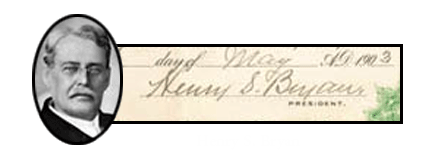
Henry S. Bryan, one of the five original founders of the Minnesota Mining and Manufacturing Company (now 3M), played a pivotal role in its inception. On June 13, 1902, in Two Harbors, Minnesota, Bryan, a businessman who had previously served as the Chief of Motive Power for the Duluth and Iron Range Railroad, provided the fledgling company with its first leadership by becoming its inaugural president. Alongside Dr. J. Danley Budd, William A. McGonagle, John Dwan, and Hermon Cable, Bryan invested in what they believed was a lucrative deposit of corundum, a crucial mineral essential for manufacturing grinding wheels.
However, Bryan’s tenure was marked by a significant setback when the mineral they were mining at Crystal Bay turned out to be low-grade anorthosite instead of corundum. This revelation led to the company’s immediate and near-ruinous failure. In response, they were forced to pivot from mining to the manufacturing of sandpaper using imported materials. While Bryan was instrumental in establishing the company’s legal and financial foundation, signing the original stock certificates that would later be worth millions, he was among the founders who eventually exited the venture. In 1905, after years of financial struggles, new investors like Lucius Ordway took control, ultimately steering the business toward the global innovation powerhouse it is today.
The Minnesota Mining and Manufacturing Company, now globally recognized as 3M, was founded in 1902 in Two Harbors, Minnesota. Initially established by five businessmen to mine corundum for abrasive use, the venture faced challenges when the mineral deposits were discovered to be low-grade anorthosite. To overcome this setback, the company pivoted from mining to manufacturing and relocated to Duluth and eventually St. Paul. Early investor Lucius Ordway’s capital and the leadership of figures like William McKnight fostered a culture centered on research and development. This shift led to the creation of groundbreaking products like the world’s first waterproof sandpaper in the early 1920s and Scotch Tape in 1930, transforming the fledgling firm into a household name.
By 2025, 3M had evolved into a diversified multinational conglomerate with over 60,000 products, including Post-it Notes, N95 respirators, and advanced electric vehicle materials. In 2002, the company officially adopted “3M Company” as its legal name to reflect its broad reach beyond its mining origins. In a significant recent strategic shift, 3M completed the spin-off of its healthcare division into a separate company called Solventum in April 2024. As of late 2025, the company is led by CEO William “Bill” Brown and operates across three primary business groups: Safety & Industrial, Transportation & Electronics, and Consumer. 3M continues to prioritize sustainability and material science innovation.




Ebay ID: labarre_galleries