

Saint Joseph and Western Railroad Co. Signed by Jay Gould - 1879 dated Autographed Stock Certificate
Inv# AG1289 Autograph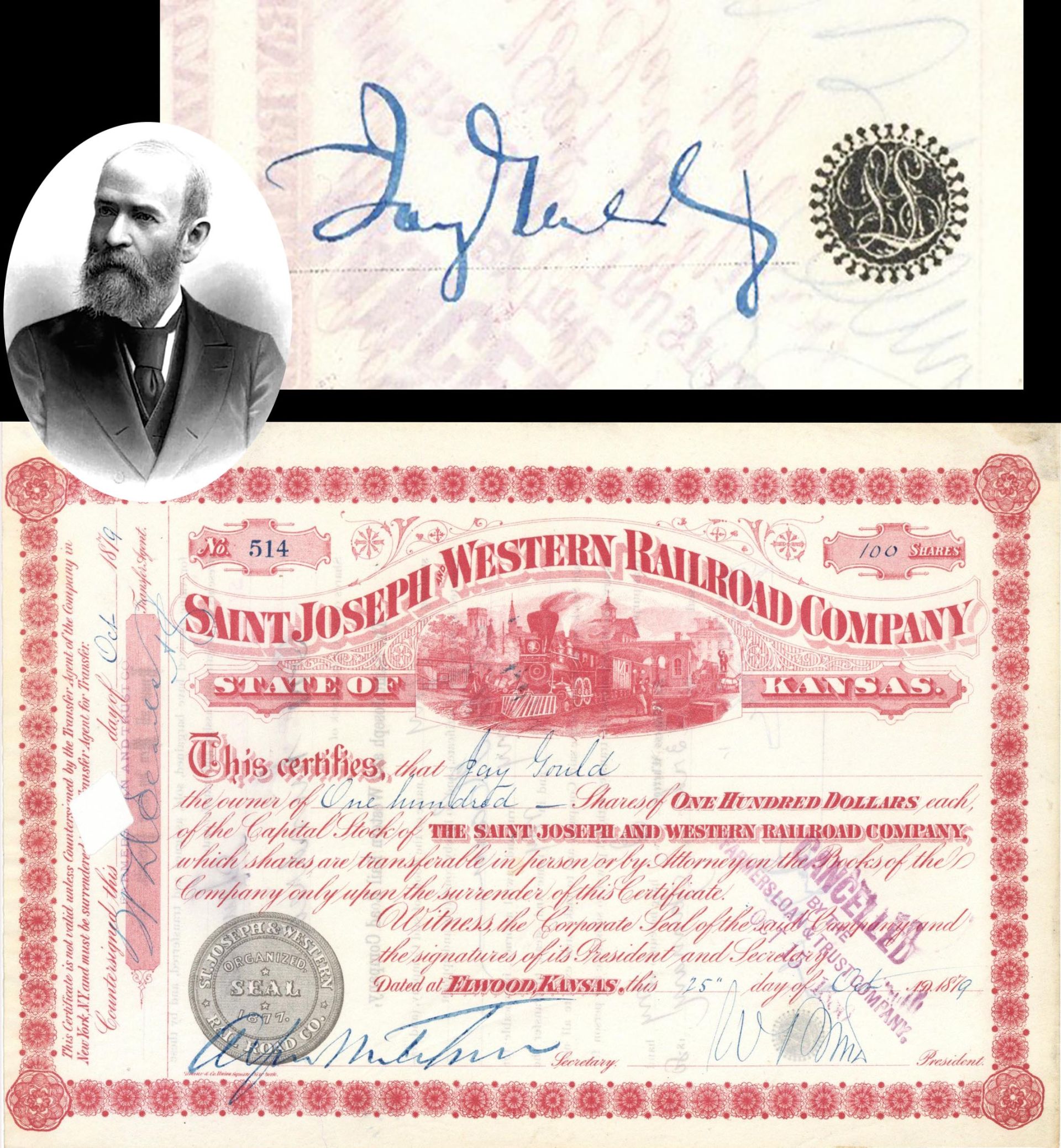
Capital Stock, issued from Elwood, Kansas to Jay Gould and signed at back. Gorgeous blue ink signature! Rare!

Jason Gould, born on May 27, 1836, in Roxbury, New York, was an American railroad magnate and financial speculator. He is often regarded as one of the robber barons of the Gilded Age. His sharp and often unscrupulous business practices made him one of the wealthiest men of the late 19th century. However, he was a highly controversial and unpopular figure during his life, widely regarded as one of the great villains of his era. Gould’s family had a long history in finance. His maternal grandfather, Alexander T. More, was a businessman, and his great-grandfather, John More, was a Scottish immigrant who founded the town of Moresville, New York. Gould attended the Hobart Academy in Hobart, New York. As a young boy, he decided that he wanted nothing to do with farming, his father’s profession, so his father dropped him off at a nearby school with 50 cents and a sack of clothes.
Despite his unconventional upbringing, Gould went on to become a prominent figure in the railroad industry. He played a key role in the expansion of the railroad network and was instrumental in the development of the Pacific Railway. Gould’s wealth and influence extended beyond the railroad industry. He was also a philanthropist and a diplomat, and he served as a member of the United States Senate.
As of 2019, Gould’s legacy continues to shape the financial world. He is the progenitor of five generations of the Gould family, who have become prominent figures in finance, philanthropy, and diplomacy. Gould’s school principal played a pivotal role in securing him a job as a bookkeeper for a blacksmith. A year later, the blacksmith offered him half interest in the blacksmith shop, which he sold to his father in the early part of 1854. During this period, Gould dedicated himself to private study, focusing on surveying and mathematics. In 1854, he embarked on a surveying project, creating detailed maps of the Ulster County, New York, area.
In 1856, Gould published two notable works: “History of Delaware County” and “Border Wars of New York,” which were the result of several years of meticulous research and writing. In 1856, Gould entered into a partnership with Zadock Pratt to establish a tanning business in Pennsylvania. The area they chose later became known as Gouldsboro. Gould eventually acquired Pratt’s interest, who had retired. Later that year, Gould formed another partnership with Charles Mortimer Leupp, a prominent leather merchant and son-in-law of Gideon Lee. This partnership was initially successful but ultimately ended during the Panic of 1857. Leupp lost all his investments in the financial crisis, while Gould seized upon the opportunity to purchase former partnership properties at discounted prices due to the depreciation in property values.
However, the Gouldsboro Tannery became a subject of contention after Leupp’s death. Leupp’s brother-in-law, David W. Lee, who had also been a partner in Leupp and Gould, took matters into his own hands. He believed that Gould had deceived the Leupp and Lee families in the collapse of the business. Gould eventually gained physical control of the tannery, but he was later compelled to sell his shares to Lee’s brother. In 1859, Gould embarked on speculative investing by purchasing stock in small railways. His father-in-law, Daniel S. Miller, introduced him to the railroad industry by suggesting that Gould assist him in saving his investment in the Rutland and Washington Railroad during the Panic of 1857. Gould acquired stock for 10 cents on the dollar, thereby gaining control of the company. Throughout the Civil War, he engaged in further speculation on railroad stocks in New York City. In 1863, he was appointed manager of the Rensselaer and Saratoga Railroad.
The Erie Railroad faced financial difficulties in the 1850s, despite receiving loans from prominent financiers such as Cornelius Vanderbilt and Daniel Drew. In 1859, the railroad entered receivership and was subsequently reorganized as the Erie Railway. Gould, Drew, and James Fisk engaged in stock manipulations known as the Erie War. In the summer of 1868, Drew, Fisk, and Vanderbilt lost control of the Erie, while Gould became its president.
During the same period, Gould and Fisk became involved with Tammany Hall, the influential Democratic Party political machine that dominated New York City at the time. They made Tammany Hall’s boss, William “Marcy” Tweed, a director of the Erie Railroad. Tweed subsequently arranged favorable legislation. In 1869, Tweed and Gould became the subjects of political cartoons by Thomas Nast. In October 1871, Gould served as the chief bondsman when Tweed was held on a $1 million bail. Tweed was eventually convicted of corruption and passed away in jail.
In August 1869, Gould and Fisk embarked on a venture to corner the gold market. Their objective was to capitalize on the anticipated rise in gold prices, which they believed would lead to an increase in wheat prices and motivate western farmers to sell their crops. Consequently, this would result in a substantial influx of shipping eastward, thereby boosting the freight business of the Erie Railroad. During this period, Gould leveraged his connections with President Ulysses S. Grant’s brother-in-law, Abel Corbin, to influence the president and his Secretary General, Horace Porter. These speculations culminated in the infamous Black Friday on September 24, 1869, when the premium over face value plummeted from 62 percent to 35 percent on a gold Double Eagle. Although Gould managed to secure a modest profit by hedging against his own failed attempt to corner the market, he ultimately lost it in subsequent lawsuits. This gold corner operation cemented Gould’s reputation in the press as a formidable figure capable of manipulating the market at will.
In 1873, Gould attempted to seize control of the Erie Railroad by enlisting foreign investments from Lord Gordon-Gordon, who was purportedly a cousin of the wealthy Campbell clan and was acquiring land for immigrants. Gould offered Gordon-Gordon a million dollars in stock, but Gordon-Gordon was an imposter who promptly cashed the stock. Gould filed a lawsuit against him, and the case went to trial in March 1873. During the trial, Gordon-Gordon provided the names of the Europeans he claimed to represent, and he was granted bail pending the verification of the references. However, he immediately fled to Canada, where he successfully convinced the authorities that the charges against him were false.
Gould failed to convince Canadian authorities to release Gordon-Gordon, so he attempted to kidnap him with the help of his associates and future members of Congress, including Loren Fletcher, John Gilfillan, and Eugene McLanahan Wilson. The group successfully captured Gordon-Gordon, but they were apprehended and arrested by the North-West Mounted Police before they could return to the US. Canadian authorities imprisoned them and refused them bail, leading to an international incident between the United States and Canada. Governor Horace Austin of Minnesota demanded their return upon learning of their denial of bail. He mobilized the local militia and thousands of Minnesotans volunteered for an invasion of Canada. After negotiations, the Canadian authorities released them on bail. Gordon-Gordon was eventually ordered to be deported but committed suicide before the order could be executed.
After being forced out of the Erie Railroad, Gould embarked on a mission to establish a network of railroads in the Midwest and West. In 1873, he seized control of the Union Pacific, which was struggling due to the Panic of 1873. He built a thriving railroad that relied on shipments from farmers and ranchers. Gould immersed himself in every operational and financial aspect of the Union Pacific system, amassing an encyclopedic knowledge and making decisive decisions to shape its destiny. Biographer Maury Klein highlights Gould’s contributions, stating that he revised the financial structure, waged competitive battles, captained political battles, revamped the administration, formulated rate policies, and promoted the development of resources along the railroad’s lines.
By 1879, Gould had acquired control of three more significant western railroads, including the Missouri Pacific Railroad. By 1882, he owned a substantial 10,000 miles (16,000 km) of railway, representing approximately one-ninth of the total rail network in the United States at that time. Moreover, he held a controlling interest in 15 percent of the country’s railway tracks. The railroads were generating profits and setting their own rates, leading to a significant increase in Gould’s wealth. However, he withdrew from the management of the Union Pacific in 1883 amidst political controversies surrounding the railroad’s debts to the federal government. Despite this, Gould realized substantial personal gains. After 1881, he acquired a controlling interest in the Western Union telegraph company and the elevated railways in New York City. In 1889, he established the Terminal Railroad Association of St. Louis, which gained control of a bottleneck in east-west railroad traffic at St. Louis. However, after Gould’s death, the government filed an antitrust suit to eliminate the bottleneck control.
The St. Joseph and Western Railroad, originally chartered in 1857 as the Marysville, Palmetto, and Roseport Railroad Company, underwent a name change to the St. Joseph and Denver City Railroad in 1862. This railroad stretched a remarkable 252 miles from St. Joseph, Kansas, to Grand Island, Nebraska, connecting these two pivotal midwestern trade centers. However, the company faced financial difficulties and entered receivership in 1874. In November of 1875, it was sold in foreclosure.
In 1879, the railroad came under the control of the Union Pacific Railroad Company, which owned a significant portion of its stocks and bonds. Consequently, it operated as the St. Joseph and Western Division of the Union Pacific, with Jay Gould, Russell Sage, and Sidney Dillon serving as directors of the company.
Acquisition of the Saint Joseph and Western Railroad was an integral part of Gould’s strategic plan to compete with the Union Pacific. He acquired it for his Wabash system as a countermeasure against the Iowa pool, a system of price agreements among potential direct competitors of Jay Gould.
Gould successfully forced the Union Pacific to buy him out through a stock swap, securing valuable UP stock in exchange. He made a substantial profit of approximately $7,000,000 on the deal. By 1890, he had acquired half of the railroad mileage in the Southwest. This stock certificate, one of the most historic, colorful, and graphic of any signed by Jay Gould, stands as a testament to his remarkable achievements.




Ebay ID: labarre_galleries