

Standard Oil Trust Stock issued to W.C. Whitney and signed by John D. Archbold and Wesley H. Tilford - 1895 dated Autograph Stock Certificate
Inv# AG1000 Autograph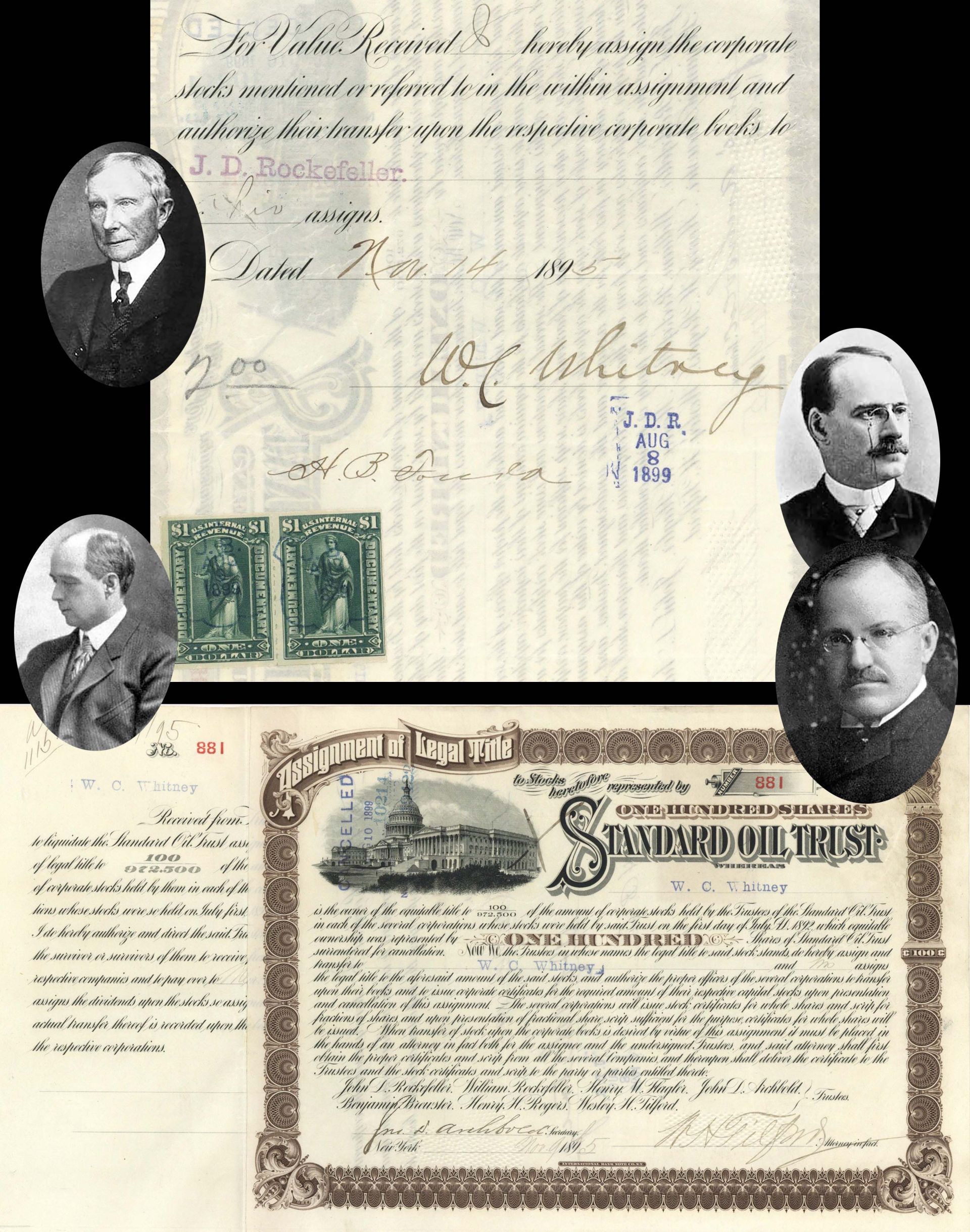
Ohio
Stock signed by John D. Archbold as secretary and Wesley H. Tilford as attorney-in-fact. Issued to and signed by W.C. Whitney on back. Also transferred to J.D. Rockefeller on back. Rockefeller, Archbold and Tilford were very important officers in the Standard Oil Trust. W.C. Whitney was the most important of the great Whitney Family.

Wesley H. Tilford (1850-1909) was born on July 14, 1850, in Lexington, Kentucky. He attended Columbia College for a brief period; however, the allure of the business world compelled him to abandon his pursuit of a bachelor's degree. Drawn by the potential of the petroleum industry, Wesley left his studies and took a position as a clerk at his brother's firm, Bostwick & Tilford, located on Pearl Street. Following the dissolution of the firm, the brothers established their own partnership under the name John B. Tilford Jr. & Co., which experienced immediate success and continued to thrive. Eventually, during the era of Eastern oil consolidations, they received a lucrative offer from the Standard Oil Company, prompting them to align their interests with this dynamic organization. These were indeed pivotal times in the oil sector, and Wesley demonstrated his capabilities through a highly successful trip to the Pacific Coast in 1878, where he played a key role in organizing the oil trade across California, Oregon, Colorado, and neighboring states.
Upon his return to the East, he was greeted with a prominent position within the home office, where he energetically and effectively addressed the extensive transportation challenges. With the respect and trust of his colleagues firmly established, he maintained this standing until the end of his career. Tilford, who served as one of the Vice Presidents of the Standard Oil Company, left behind a distinguished legacy of over thirty years with the Company, along with several years in a petroleum enterprise associated with his family. Throughout his career, he navigated all levels of petroleum merchandising, consistently demonstrating loyalty, integrity, and insight in each role he undertook. Prior to his promotion to Vice President in 1908, he served as Treasurer of the Standard Oil Company for nine years and had been a Director since 1892. Despite his extensive and notable career, he remained relatively unknown outside the oil industry due to his unassuming nature. He was a man of few words, yet possessed a profound understanding of business matters, particularly excelling in organizational skills and possessing sound judgment. Additionally, he was well-read and knowledgeable across various subjects. His demeanor was courteous, compassionate, and generous. While ordinary qualities, enhanced by business experience, may suffice for navigating the intricacies of an established enterprise, achieving and maintaining a leading position in a dynamic and expanding business requires exceptional attributes. His colleagues attested that he consistently merited his advancements, a commendation from individuals who themselves were contemporaries of the titans of business throughout history.

John Dustin Archbold (born July 26, 1848, in Leesburg, Ohio; died December 6, 1916, in Tarrytown, New York) was a prominent American capitalist and one of the pioneering oil refiners in the United States. His modest oil enterprise was acquired by John D. Rockefeller's Standard Oil Company. Archbold quickly advanced within Standard Oil, managing numerous intricate and confidential negotiations throughout the years. By 1882, he had become Rockefeller's closest confidant and frequently served as the company's principal spokesperson. Following 1896, Rockefeller delegated business responsibilities to Archbold as he focused on his philanthropic endeavors; as vice president, Archbold effectively oversaw the operations of Standard Oil until his passing in 1916. Influenced by Rockefeller's strategies, Archbold prioritized stabilization, efficiency, and the reduction of waste in the refining and distribution of petroleum products. In 1911, the Supreme Court mandated the dissolution of the company into approximately thirty-six smaller entities, after which Archbold assumed the presidency of the largest, Standard Oil of New Jersey.

W. C. Whitney (1841-1904) An American political leader and financier and founder of the prominent Whitney family.
William Whitney was born at Conway, MA of Puritan stock. He graduated from Yale University in 1863 then studied law at Harvard, and practised with success in New York City. He was an aggressive opponent of the Tweed Ring, and was actively allied with the anti-Tammany organizations, the Irving Hall Democracy of 1875-1890, and the County Democracy of 1880-1890, but upon the dissolution of the latter he became identified with Tammany.
He married Flora Payne, the sister of his wealthy Yale classmate Oliver Hazard Payne. Through his marriage to Flora Payne, Whitney gained enormously important corporate contacts.
In 1875-1882, he was corporation counsel of New York, and as such brought about a codification of the laws relating to the city, and successfully contested a large part of certain claims, largely fraudulent, against the city, amounting to about $20 million, and a heritage from the Boss Tweed regime.
In 1883, he became involved in a bitter struggle for control of the Broadway Railroad company, eventually gaining control by entering into an alliance with Thomas Fortune Ryan and Peter A. B. Widener. Whitney remained active in street railway affairs until his appointment as Secretary of the Navy (1885-89), in which post he was instrumental in the rebuilding of America’s naval forces.
During President Cleveland's first administration (1885-1889), Whitney was United States Secretary of the Navy and did much to develop the United States Navy, especially by encouraging the domestic manufacture of plate armor.
In 1892, he was instrumental in bringing about the third nomination of Cleveland, and took an influential part in the ensuing presidential campaign. In 1896, however, disapproving of the "free-silver" agitation, he refused to support his party's candidate, William Jennings Bryan. Whitney took an active interest in the development of public transport in New York, and was one of the organizers of the Metropolitan Street Railway Company. He was also interested in thoroughbred horse racing and established a racing operation with a string of race horses, competing against the successful stable of business associate, James R. Keene. A breeder of twenty-six American stakes winners, in 1901, Whitney won England's Epsom Derby with Volodyovski, leased by him from Lady Meux.

John Davison Rockefeller (1839-1937) Founder and one of the original partners of Standard Oil; Oil industry pioneer; Capitalist. At one time reputedly the world's richest man, Rockefeller began his career in Cleveland, Ohio as a successful merchant, prior to the Civil War. In 1863, he and his partners built a refinery which grew into a business that eventually absorbed many other Cleveland refineries and expanded into Pennsylvania oil fields to become the world's largest refining concern. During this time, he was able to expand his operations while others were failing due the talented people with whom he had surrounded himself, to the efficiency of his operations, and to a variety of what are now considered unscrupulous business practices for which he became famous.
In 1870, Rockefeller organized the Standard Oil Company of Ohio in order to improve the efficiency with which his operations were being run. In 1882, in part to streamline operations, and in part to avoid state controls, Rockefeller took a step which had a profound significance for American business by creating the Standard Oil Trust. Under this arrangement, a board of trustees took the stock of both the Standard Oil Company of Ohio and of all of its subsidiaries, and ran the combination through the board's executive committee. By this time, public criticism of Rockefeller and his methods was running at near-fever pitch and, in 1892, the Trust was dissolved by the Ohio Supreme Court. The Trust was divided into some 18-later over 30-corporations before being folded into another holding company, Standard Oil of New Jersey (1899).
In 1911, the U.S. Supreme Court ordered this latter company dissolved, declaring that it was "a monopoly in restraint of trade," and thus illegal under the Sherman Anti-Trust Act. By this time Rockefeller had almost completely removed himself from business concerns, and was concentrating solely on his philanthropic projects. While the extent of his philanthropies are too numerous to list, among the most prominent are his founding of the University of Chicago (1889), the Rockefeller Institute for Medical Research (1901), the General Education Board (1902) and the Rockefeller Foundation (1913). It is estimated that Rockefeller gave away some $550 million during his lifetime.
Some of the old headlines read “Rockefeller Indicted Again”, “Standard Oil Before the Bar”, “Standard Oil Magnates Dodge Subpoenas”, “Rockefeller Faces Justice”, Later headlines changed dramatically in tone including “Rockefeller Gives Another Million to Unemployment Fund”, “Rockefeller Foundation Fights Pellagra in Georgia”, and “John D. Gives Dimes to Children”. Some speculate that his habit of giving dimes to people he met was based on the advice of Ivy Ledbetter Lee in 1914 who was hired to help manage the Rockefeller Empire’s image. Lee is considered the leading pioneer of today’s public relations industry, working first for J.P. Morgan, then for Rockefeller.
John D. Rockefeller soon engaged in the practice of carrying around a bag of dimes, handing one to everyone he met. Many people feel that this was John D Rockefeller’s way of getting closer to the public. It is said that he used to do it with relish, and so when someone approached him he would hand him a shiny dime in order to start a conversation. Late in life Rockefeller became known as "The Man Who Gave Away Shiny New Dimes". He reportedly gave away about $10,000 worth of dimes before his death, 100,000 Mercury dimes! A quote from Golf Digest-2002… “By 1920 Rockefeller already had become famous for handing out dimes to street urchins whom he thought deserving of spiritual encouragement or moral reward, and in Florida one winter he bestowed a dime on Harvey Firestone, president of the tire and rubber company, for having made a long and treacherous downhill putt.”
An additional quote from the biography “John D. Rockefeller” by Barnie F. Winkelman states “The shiny dimes that the aging Rockefeller handed out were a symbol and a sermon. The symbol was frequently misunderstood and the moral of the sermon quite generally distorted. The little gift was a token and a good-luck piece. In a broad sense it emphasized thrift, but not as a sure road to wealth, rather as a way and a habit of life.” Winkelman further offers a quote by Rockefeller “It is the duty of a man to get all the money he honestly can and to give all he can. This is the basis of progress. In this way morality and religion move forward and civilization is advanced.”




Ebay ID: labarre_galleries