


Republican Insitution Signed by Henry Dearborn and PASS-CO Authenticated - 1821 datedAutographed Stock Certificate - Exceptional from Boston, Massachusetts
Inv# AG1101A Autograph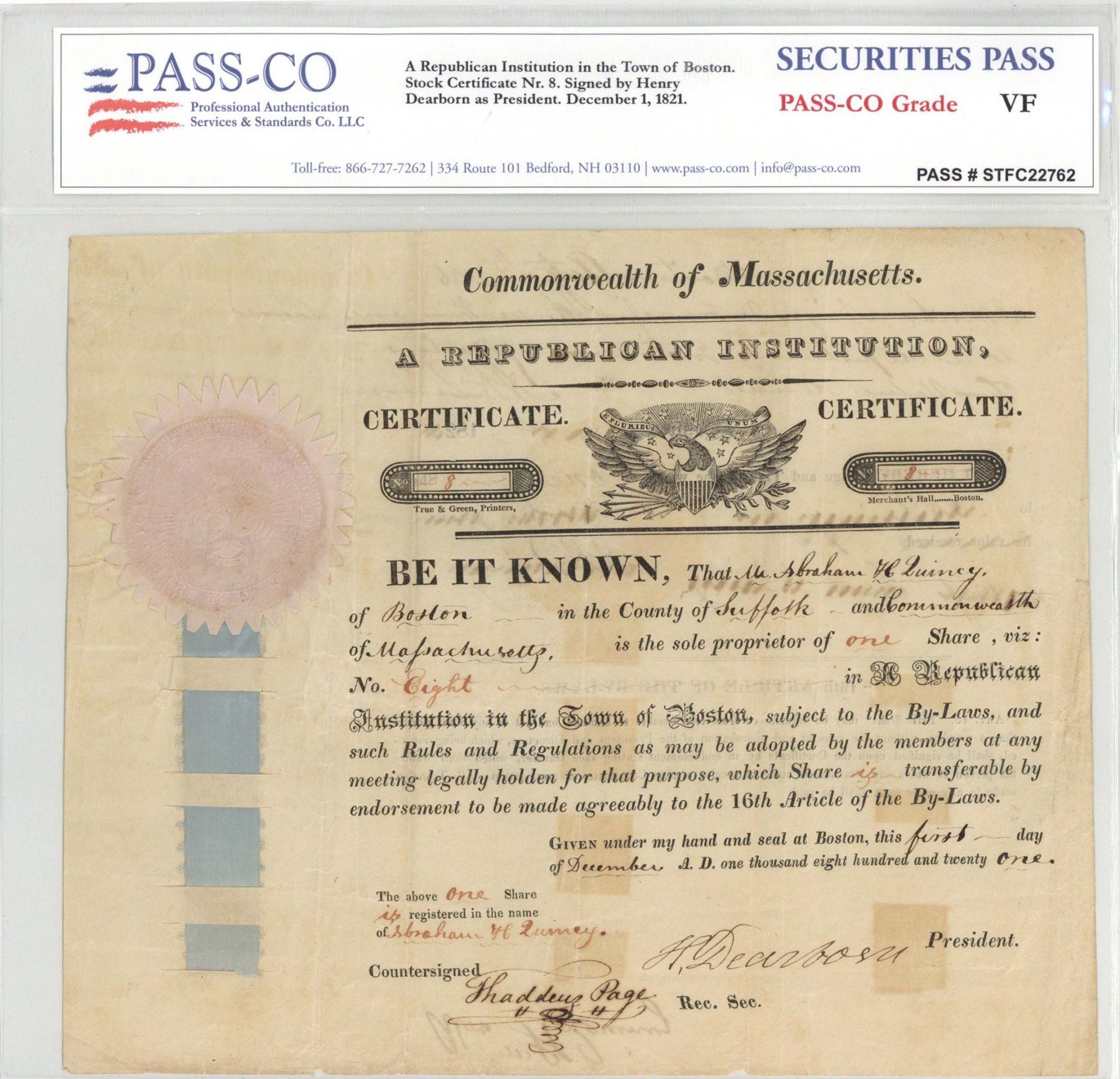
Henry Dearborn autographs this impressive 1821 stock at front as President. It bears an applied paper seal with neatly attached blue ribbon. Quite Rare and Most Important! Also available PASS-CO authenticated at same price. Excellent Condition!
Henry Dearborn autographs this impressive 1821 stock at front as President. It bears an applied paper seal with neatly attached blue ribbon. Quite Rare and Most Important!
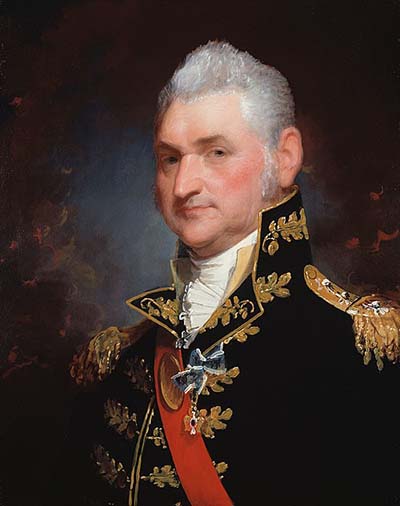
Henry Dearborn (1751–1829) was an American physician, general, and statesman who played a pivotal role in both the American Revolution and the early formation of the United States government. Born in North Hampton, New Hampshire, Dearborn initially pursued a medical career under the guidance of Dr. Hall Jackson and established a medical practice in 1772. However, his medical endeavors were abruptly interrupted by the outbreak of the Revolutionary War. In response, he swiftly organized a local militia and distinguished himself as a captain at the Battle of Bunker Hill. Later that year, he joined Benedict Arnold’s arduous expedition to Quebec, where he was unfortunately captured by British forces. After a prisoner exchange, Dearborn rejoined the Continental Army and participated in crucial battles such as Saratoga and Monmouth. He endured the grueling winter at Valley Forge and ultimately served on General George Washington’s staff during the decisive British surrender at Yorktown.
Following the war, Dearborn successfully transitioned into a prominent political career. He relocated to Maine, where President Washington appointed him the district’s inaugural U.S. Marshal. Subsequently, he secured election to the U.S. House of Representatives. Dearborn’s political influence surged significantly when President Thomas Jefferson appointed him as the U.S. Secretary of War, a position he held from 1801 to 1809. During his tenure, he oversaw the reduction of the standing army and famously ordered the construction of Fort Dearborn, which later became the foundation of Chicago. However, his later military career proved less successful. As a senior major general in the War of 1812, his commands faced tactical delays and a failed invasion of Canada. Consequently, President James Madison relieved him of command in 1813. Dearborn concluded his public service as the U.S. Minister to Portugal under President James Monroe before retiring to Massachusetts, where he passed away in 1829.
The Commonwealth of Massachusetts holds a significant place in the history of American republicanism, rooted in its seventeenth-century colonial origins. Initially established by the Pilgrims at Plymouth in 1620 and the Puritans of the Massachusetts Bay Colony in 1630, the region witnessed early experiments in self-governance. The signing of the Mayflower Compact introduced an early framework of civic cooperation, which later evolved into the system of town meetings—a form of direct democracy that empowered local citizens to vote on laws and budgets. As tensions with Great Britain escalated in the late eighteenth century, Massachusetts emerged as the epicenter of the American Revolution. Influential figures like John Adams, Samuel Adams, and James Otis passionately advocated for the classical republican ideals of civic virtue, resistance to tyranny, and a government deriving its legitimacy solely from the consent of the governed.
In 1780, amidst the turmoil of the Revolutionary War, the state codified these principles by adopting the Constitution of the Commonwealth of Massachusetts. Drafted primarily by John Adams, this document stands as the world’s oldest functioning written constitution and served as a crucial blueprint for the United States Constitution. It explicitly delineated Massachusetts as a “free, sovereign, and independent body politic, or state, by the name of The Commonwealth of Massachusetts.” The deliberate choice of the word “commonwealth” underscored a republican government dedicated to the collective well-being of the public, rather than the interests of a monarch or an elite class. By establishing a clear separation of powers among the executive, legislative, and judicial branches, along with a robust declaration of rights, the Massachusetts Constitution permanently established an institutional framework designed to safeguard individual liberties through structured representative rule.




Ebay ID: labarre_galleries