

Northern Pacific Railroad Co. signed by William. G. Fargo - 1876 dated Autograph Stock Certificate
Inv# AG1925B Stock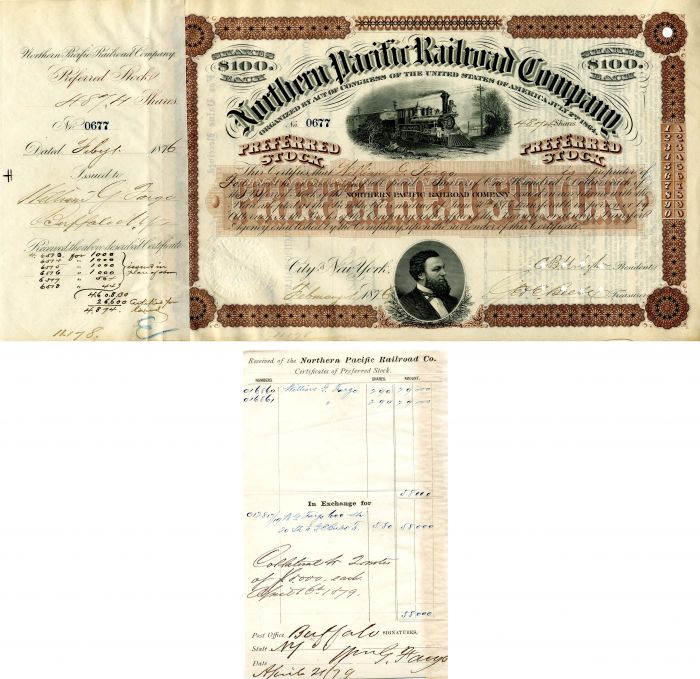
Stock issued to and signed by William George Fargo.

William George Fargo (1818-1881), a pioneer in the American express industry, co-founded both Wells Fargo and the American Express Company. Born in Pompey, New York, in 1818, Fargo left school at thirteen to carry mail, embarking on a lifelong career in transportation and freight. After gaining experience as a freight agent for the Auburn and Syracuse Railroad, he joined Henry Wells and Daniel Dunning in 1844 to form Wells & Company. This venture rapidly expanded parcel delivery west of Buffalo, New York. In 1850, a merger of competing express lines led to the creation of the American Express Company, with Fargo serving as its first secretary. Recognizing the immense opportunity presented by the California Gold Rush, Fargo and Wells organized Wells, Fargo & Company in 1852 to provide express and banking services to the Pacific coast, establishing a financial empire that connected the eastern and western United States.
Beyond his remarkable success in corporate transit and banking, Fargo was a prominent civic leader and politician. Settling in Buffalo, New York, he served two terms as the city’s mayor during the American Civil War, from 1862 to 1866, as a Democrat who steadfastly supported the Union. From 1868 until his death in 1881, Fargo served as the president of American Express, guiding the company through post-war expansion and the rise of the transcontinental railroad. He also invested significantly in regional railroads, manufacturing, and local real estate, famously constructing the Fargo Mansion, the largest private residence in Buffalo at the time. Fargo passed away on August 3, 1881, leaving behind a lasting legacy as a titan of American commerce whose name remains synonymous with global financial services.
The Northern Pacific Railroad, chartered by Congress in 1864, was envisioned as a crucial transcontinental link connecting the Great Lakes with the Pacific Northwest. Backed heavily by financier Jay Cooke, the ambitious project officially commenced construction in 1870, with efforts pushing westward from Minnesota and eastward from Washington Territory. However, progress abruptly halted in 1873 when Cooke’s banking firm collapsed, triggering a severe national financial panic that ultimately bankrupted the railroad. Despite this devastating setback, the company reorganized under new leadership and secured fresh capital. Driven by the determination of railroad tycoon Henry Villard, thousands of laborers, including a substantial workforce of Chinese immigrants, persevered through rugged plains and formidable mountain ranges to finally complete the mainline in Montana in 1883.
The completion of the Northern Pacific Railroad revolutionized the American Northwest, serving as a powerful catalyst for economic and population growth. By significantly reducing travel times to just a few days, the railroad opened the remote region to global markets, transforming small settlements like Seattle, Tacoma, and Minneapolis into vibrant commercial hubs. Additionally, the railroad actively recruited European settlers with promises of affordable, fertile farmland along its right-of-way, which sparked a thriving agricultural empire centered around wheat and timber. Although the company encountered ongoing financial challenges and another bankruptcy in the 1890s, it remained a dominant transportation force for nearly a century until its 1970 merger into the Burlington Northern Railroad. This merger left an indelible mark on the geography and economy of the United States, solidifying the railroad’s enduring legacy.
A stock certificate is issued by businesses, usually companies. A stock is part of the permanent finance of a business. Normally, they are never repaid, and the investor can recover his/her money only by selling to another investor. Most stocks, or also called shares, earn dividends, at the business's discretion, depending on how well it has traded. A stockholder or shareholder is a part-owner of the business that issued the stock certificates.




Ebay ID: labarre_galleries