


New York and Harlem Railroad Co. signed by Jacob Little - 1850 dated Autographed PASS-CO authenticated Railway Stock Certificate
Inv# AG1076A Autograph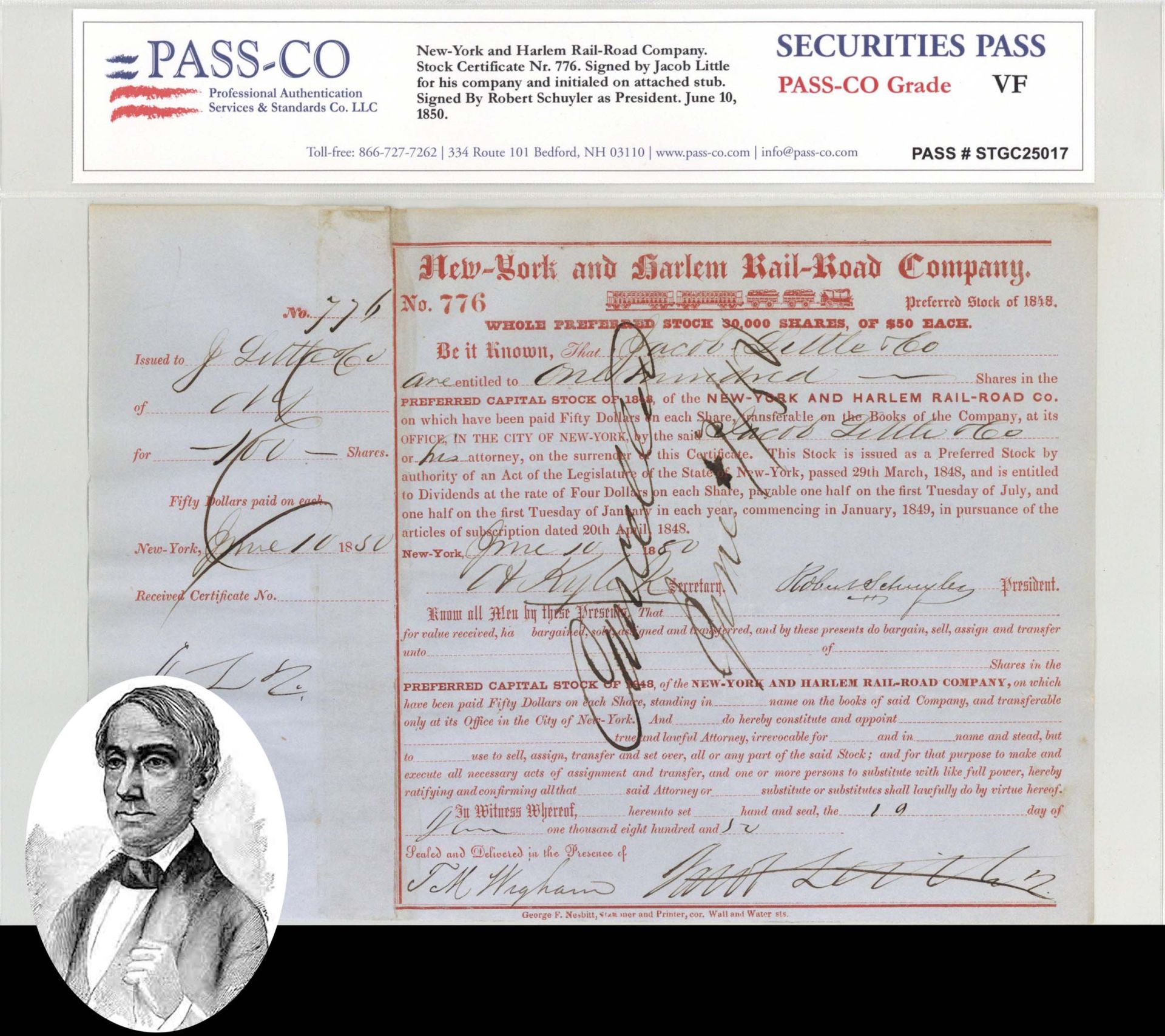
Pass-Co Graded VF Stock issued to Jacob Little & Co. and signed by Jacob Little and Initials for his company.

Jacob Little (1794-1865), a prominent speculator in Erie Railroad stocks during the 1850s, was a top manipulator of the stock market. His speculations led to significant gains and losses, resulting in the adoption of the “option limit of sixty days” to prevent manipulation on the “short” side.
Born in Newburyport, Massachusetts, Little exhibited exceptional business acumen from a young age. In 1817, he moved to New York City and joined Jacob Barker, a renowned merchant, where he honed his financial skills and completed his education in business.
In 1822, Little established his own office on Wall Street, demonstrating remarkable caution, self-reliance, integrity, and foresight. He dedicated himself to business, working tirelessly for eighteen hours a day and visiting retail houses to acquire uncurrent money.
Little’s strategic approach involved establishing correspondence with prominent bankers across major cities. After twelve years of unwavering industry, integrity, and dedication, he emerged as the head of financial operations on Wall Street, embracing the “Bearing Stocks” style and earning the nickname “The Great Bear.”
Little’s business acumen allowed him to amass an almost unimaginable fortune, but his reliance on this system ultimately led to his downfall. For over a quarter of a century, his office in the historic Exchange building served as the epicenter of daring and colossal speculations, and he was known for his swift and decisive actions on the stock exchange. Despite his vast stock holdings, Little was called the “Napoleon of the Board.” When capitalists were wary of railroads, Little led the movement, seeing the potential for profits. This move made him the “Railway King” and a wealthy man.
Remarkably, Little foresaw the railroad business’s peak and shifted his focus. At that time, the Erie stock was popular and trading at par. Mr. Little had contracted to sell a large amount of this stock, to be delivered later. His Wall Street rivals conspired, buying all his contracts and new stock, blocking his path. His downfall seemed inevitable, as they had his contract and stock.
The stock delivery day arrived. At one o’clock, Mr. Little entered the Erie company office. He presented certificates of indebtedness, which promised stock. He demanded stock, and they had no choice but to comply. With the stock, he fulfilled his contract, outmaneuvered the conspirators, and won.
One day, walking from Wall Street with a friend, they passed Union Square, home to the wealthy. As they gazed at the elegant houses, Mr. Little said, “I’ve lost enough money today to buy this entire square and half the people in it.”
Despite facing three bankruptcies, Mr. Little recovered each time and fulfilled his contracts. Capitalists said, “Jacob Little’s suspended papers were better than most men’s checks.”
Mr. Little, tall and slim with expressive eyes, exuded confidence and commanded respect. Though reserved outside business, he was generous as a creditor, never pressuring those he believed honest. After his first suspension, despite being free, he paid every creditor in full, even if it meant nearly a million dollars. A devout Episcopalian, his charitable works were substantial, discreet, and non-sectarian. The Southern Rebellion devastated his fortune, yet he accepted the loss as a sacrifice for his country. He passed away in his family’s embrace, his final words, “I am ascending. Who will accompany me?”
The New York and Harlem Railroad Company, established in 1831, stands as one of the pioneering railroads in the United States and the very first street railway globally. Conceived by Vice President Aaron Clark and a group of forward-thinking New York businessmen, the line was designed to connect the vibrant commercial hub of Lower Manhattan with the suburban areas of Harlem. Its inaugural journey commenced in November 1832, utilizing horse-drawn streetcars that traversed Fourth Avenue from Prince Street to 14th Street. As the city’s population surged and technological advancements emerged, the railroad transitioned from horse-drawn power to steam locomotives. Gradually, it extended its tracks northward, overcoming formidable rock formations such as the Murray Hill tunnel and crossing the Harlem River to reach Westchester County and eventually Albany by the 1850s.
In 1863, the renowned financier Cornelius “Commodore” Vanderbilt acquired a controlling interest in the New York and Harlem Railroad, marking a significant turning point in American transportation history. Vanderbilt strategically leveraged the railroad as the cornerstone of his expanding transportation empire, later merging it with the New York Central and Hudson River Railroad. This strategic consolidation solidified the line’s pivotal role in passenger travel, culminating in the construction of the iconic Grand Central Depot in 1871, serving as its grand Manhattan terminus. While the northern freight and passenger lines eventually integrated into modern commuter networks like Metro-North Railroad, the inner-city streetcar segments were transformed into bus routes, leaving an indelible mark on the geographic development and transit infrastructure of contemporary New York City.




Ebay ID: labarre_galleries