


New York Central and Hudson River Railroad Co. signed by Edward Van Wyck Rossiter - 1894 dated Autographed Stock Certificate
Inv# AG1940A Autograph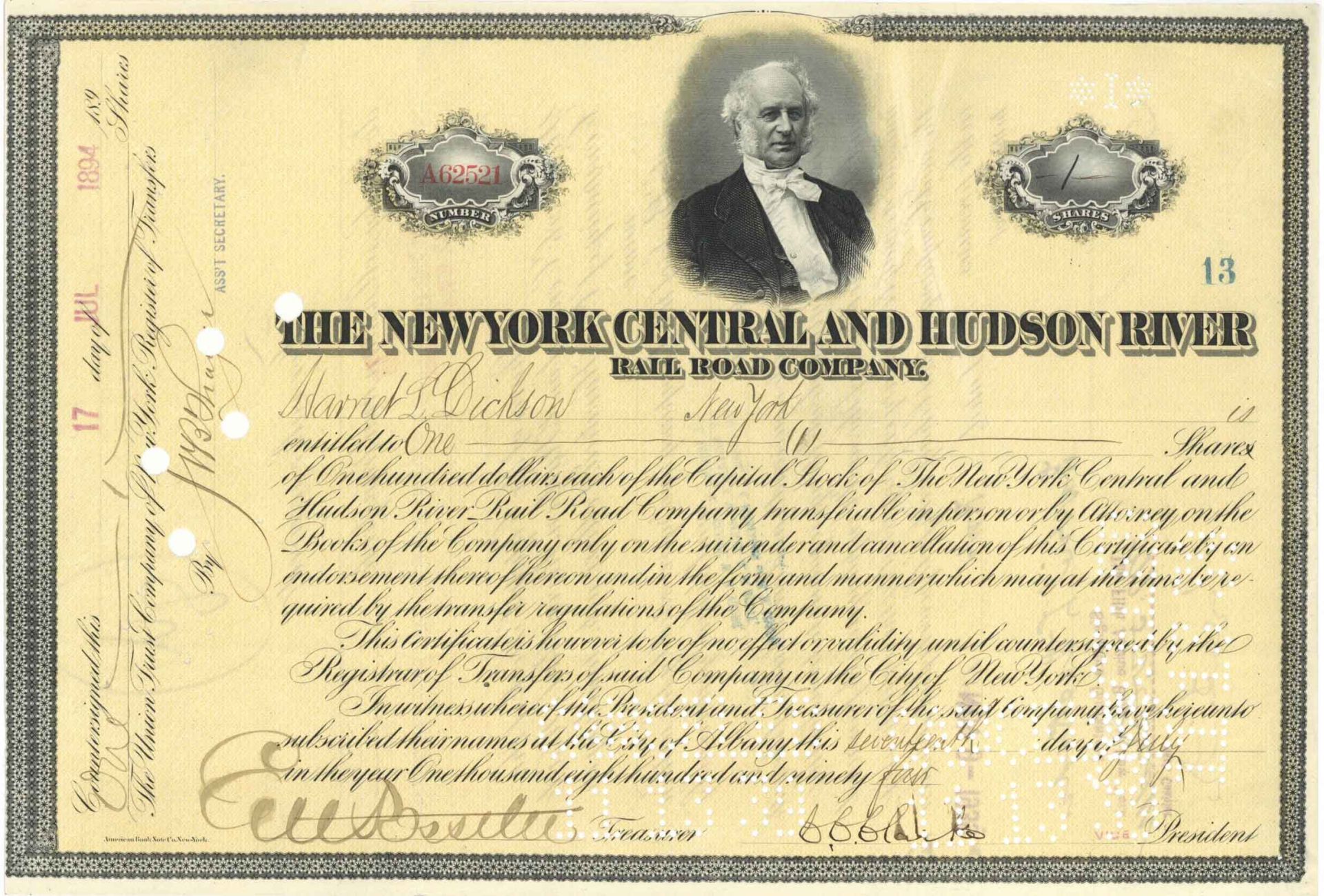
Stock printed by American Bank Note Co., New York and signed by E.V.W. Rossiter as treasurer.

Edward Van Wyck Rossiter (1844–1910) was a prominent American financial executive of the 19th century. He dedicated his entire half-century career to shaping the infrastructure of the New York Central Railroad network. Born into a comfortable New York family, Rossiter entered the railroad industry at the young age of sixteen in 1860. Initially, he served as a president’s clerk for the Hudson River Railroad. Over the next several decades, his exceptional aptitude for corporate finance propelled him through a series of key promotions. He held positions such as cashier and eventually treasurer for the New York & Harlem Railroad before becoming Vice President of the New York Central and Hudson River Railroad in November 1900. His financial leadership extended to almost all lines affiliated with the parent company and executive responsibilities at the Lincoln National Bank and Lincoln Safe Deposit Company.
Beyond his corporate achievements, Rossiter was a prominent figure in New York’s elite social and civic circles. He resided at a prominent home on Sanford Avenue in Flushing, Long Island, with his wife, Estelle Hewlett Rossiter. Together, they raised four sons and two daughters. Known for his dedicated work ethic, Rossiter continued to manage complex railroad operations until just three weeks before his death from illness in December 1910. His profound impact on his industry and community was evident at his packed funeral at St. George’s Church. Hundreds of railroad employees were granted a special half-holiday to attend alongside delegations from the Chamber of Commerce, the Union League Club, and high-ranking railroad presidents.
The New York Central Railroad (NYCR) played a pivotal role in shaping the economic landscape of the United States by connecting the East Coast with the Midwest. Established in 1853 through the merger of several smaller lines across New York State, the railroad found its true visionary leader in industrialist Cornelius Vanderbilt in 1867. Vanderbilt strategically expanded the network, linking New York City to crucial trade hubs such as Chicago, Boston, and St. Louis. Renowned as the “Water Level Route” due to its tracks following natural river valleys instead of traversing rugged mountains, the NYCR provided a remarkably smooth and fast journey for both passengers and freight. It became an iconic symbol of American culture, famously operating the 20th Century Limited—a legendary luxury train that epitomized the pinnacle of twentieth-century rail travel.
However, as the mid-twentieth century dawned, the rise of interstate highways and commercial aviation severely weakened the railroad’s dominance. Despite engineering marvels like the massive Grand Central Terminal in Manhattan, the company grappled with mounting financial losses in the post-World War II era. In a desperate attempt to survive, the New York Central merged with its formidable long-time rival, the Pennsylvania Railroad, to form the Penn Central Transportation Company in 1968. This monumental merger failed to halt the financial decline, leading to a historic bankruptcy just two years later. While the company itself has ceased operations, its legacy endures through Amtrak and Metro-North Railroad, which continue to provide passenger services over the historic tracks laid down by the New York Central.




Ebay ID: labarre_galleries