


 Fairport and Phalanx Railroad Co. Issued to E.V.W. Rossiter and signed by James Rudolph Garfield, transferred to Wm. K. Vanderbilt - 1908 dated Autograph Railway Stock Certificate
Inv# AG2320A
Autograph
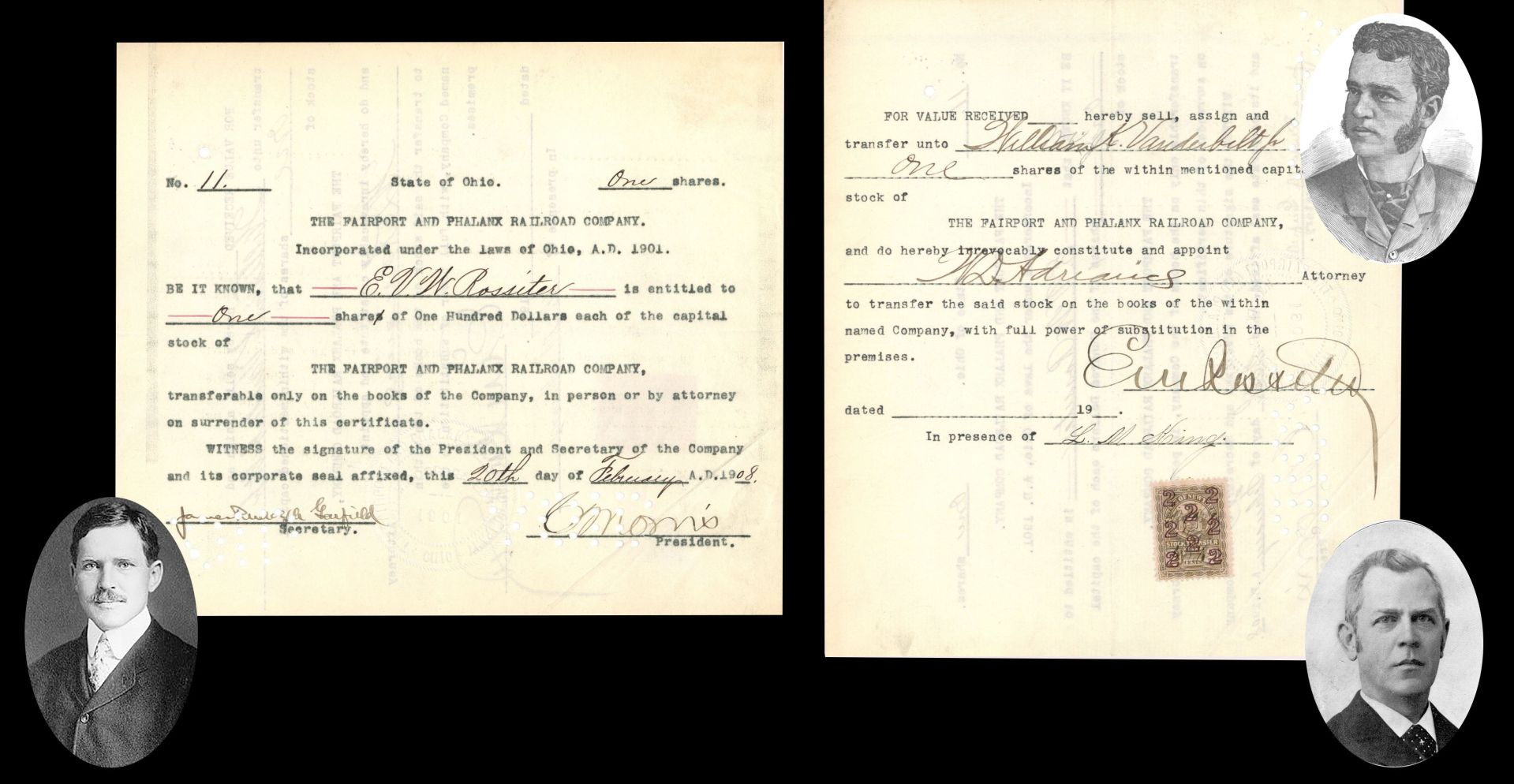
Stock certificate #11 signed by James Rudolph Garfield, issued to E.V.W. Rossiter and signed on back. Also transferred to William K. Vanderbilt on back. Included is a copy of a list of stockholders and stocks issued.
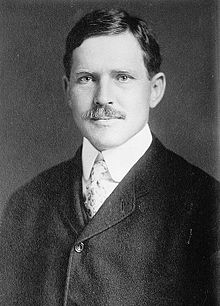
James Rudolph Garfield (October 17, 1865 – March 24, 1950) was an American lawyer and politician. Garfield was a son of President James A. Garfield and First Lady Lucretia Garfield. He served as Secretary of the Interior during President Theodore Roosevelt's administration.
Garfield was born in Hiram, Ohio, the third of seven children born to James Abram and Lucretia Rudolph Garfield. For a year prior to his father's presidency, he studied at St. Paul's School in Concord, New Hampshire. On July 2, 1881, at the age of 15, he and his 17-year-old brother, Harry Augustus Garfield, witnessed the shooting of their father by disgruntled office-seeker Charles J. Guiteau at the Baltimore and Potomac railroad station in Washington. The President and his sons were waiting for a train en route to Williams College in Williamstown, Massachusetts, where young James had been recently accepted, when the shooting took place.
Following his father's death on September 19, 1881, Garfield studied at Williams College. He received his A.B. degree in 1885, and then attended Columbia Law School. In 1888, he was admitted to the Ohio bar and established the Cleveland, Ohio-based law firm of Garfield and Garfield, with his brother Harry Augustus Garfield. From 1890 until her death in 1930, he was married to Helen Newell. They had four sons, John, James, Newell, and Rudolph. Their grandson, Newell Garfield, later married Jane Harrison Walker, a granddaughter of President Benjamin Harrison and Harrison's second wife, Mary Dimmick Harrison, as well as the great-grandniece of James G. Blaine.
From 1896 to 1899, Garfield served in the Ohio State Senate. He was an influential advisor to President Theodore Roosevelt, serving as a Member of the United States Civil Service Commission from 1902 to 1903. From 1903 to 1907, he served as Commissioner of Corporations at the Department of Commerce and Labor, where he conducted investigations of the meat-packing, petroleum, steel, and railroad industries. From 1907 to 1909, he served in Roosevelt's Cabinet as Secretary of the Interior, where he advocated for the conservation of natural resources. He left this post on March 4, 1909, and returned to his law practice in Cleveland. In 1909, he received an honorary LL.D. degree from the University of Pittsburgh. Garfield was a contender for the Ohio Republican gubernatorial nomination in the 1910 election but withdrew from the convention when it endorsed the Taft Administration; the convention went on to nominate future president Warren G. Harding in the third round of balloting. During the 1912 presidential election, he was a key supporter of Roosevelt's bid for a third term. In the 1914 election, he made an unsuccessful bid for Governor of Ohio on the Progressive Party ticket.
Former President Theodore Roosevelt selected Garfield as one of eighteen officers including Seth Bullock, Frederick Russell Burnham, John M. Parker, and Henry L. Stimson to raise a volunteer infantry division, Roosevelt's World War I volunteers, for service in France in 1917. The United States Congress gave Roosevelt the authority to raise up to four divisions similar to the Rough Riders of the 1st United States Volunteer Cavalry Regiment and to the British Army 25th (Frontiersmen) Battalion, Royal Fusiliers; however, as Commander-in-chief, President Woodrow Wilson refused to make use of the volunteers and the unit disbanded.
Garfield died in Cleveland, Ohio, on March 24, 1950, and was the last surviving member of President Theodore Roosevelt's cabinet. He had survived his father by 68½ years. He was interred in Mentor Municipal Cemetery in Mentor, Ohio, beside his wife Helen.

Edward Van Wyck Rossiter (1844-1910) President’s clerk for Hudson River Railroad; Treasurer’s office clerk for Hudson River Railroad 1860-67; cashier New York & Harlem Railroad 1867-77. Later treasurer of same company, June 1883 became treasurer and from November 1900 had been Vice President of New York Central and Hudson River Railroad, New York & Harlem Railroad as well as of almost all the lines affiliated with the New York Central Company, also Lincoln National Bank and Lincoln Safe Deposit Company.
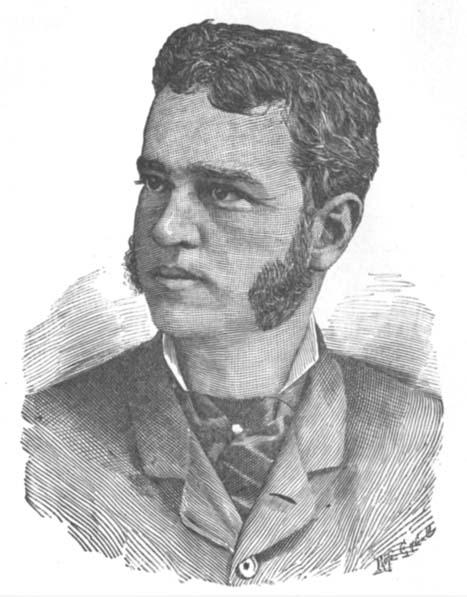
William K. Vanderbilt, Jr. (1878-1944) was a prominent railroad executive and the son ofWilliam K. Vanderbilt. He began his career with the New York Central Lines in 1903, quickly rising through the ranks. By 1910, he was appointed assistant to the President, and in 1912, he became Vice President. In 1918, Vanderbilt assumed the role of President. In addition to his railroad career, he served as a Director of the Western Union Telegraph Company. During World War I, from 1917 to 1918, he served in the U.S. Navy.




Ebay ID: labarre_galleries